
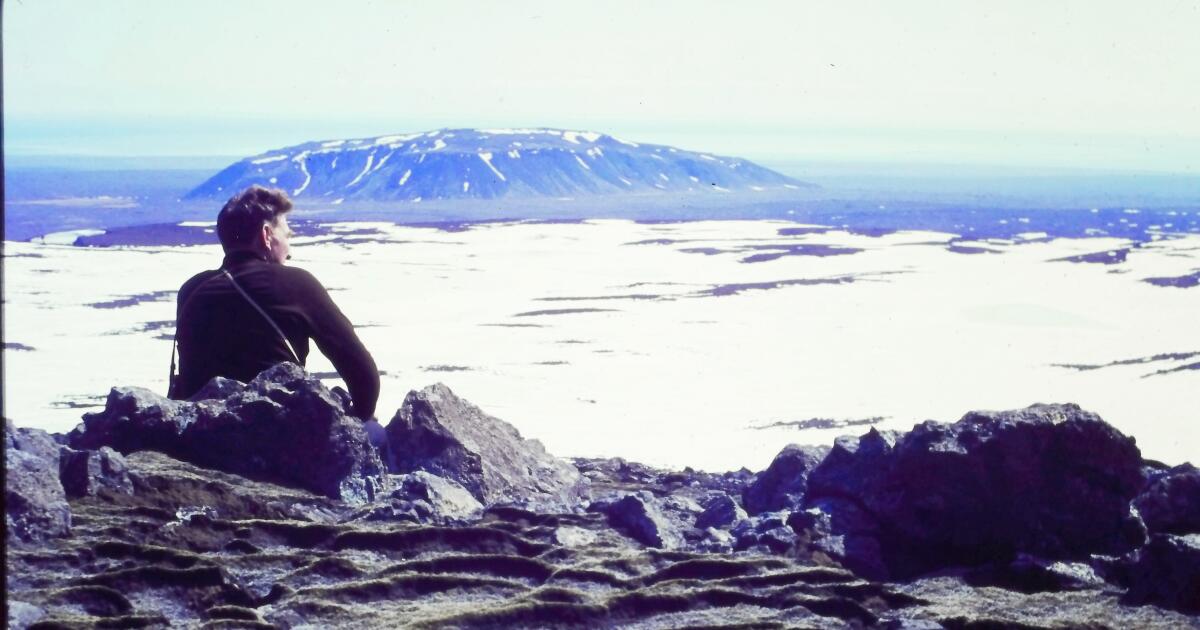
Glaciers aren’t stationary. Immense and imposing, formed through the downward trajectory of water from mountains as it collects and freezes, they have always moved. Now, however, they’re leaving. The demise of glaciers is a fact inherent in all the bad news about the effects of climate change on what once seemed permanent. But for Icelanders, whose connection to glaciers is ancient and mythic, our human epoch has become an extended hospice for the landscape of their lives.
Somehow, though, Sara Dosa’s documentary on this matter, “Time and Water,” avoids playing like a funeral in waiting. Built around Icelandic writer Andri Snær Magnason’s voiced lamentations on a vanishing frozen world, along with archival footage of his family, it’s no simple howl of grief, even when it takes us to a publicly held memorial in 2019 for Iceland’s Ok glacier, the first such “death” diagnosis in the country’s history. Rather, Dosa’s film is a meditation on change — both the kind that we accept with a heavy heart and something more general. “Time and Water” is a curiously vibrant elegy, teeming with appreciation for the intimate majesty that is all life, generational and geologic.
Dosa has finessed this emotional-meets-elemental space before in her Academy Award-nominated 2022 documentary “Fire of Love,” about married volcanologists Katia and Maurice Krafft. That was a wonderfully eccentric romance forged in molten lava. Here, she’s in a collaboration of sorts with her subjects, both human and elemental. Magnason’s opening narration over spectacular footage of glaciers — up close and from far away — gently informs us that we’re watching a time capsule, one where the bonds of family and environment are intertwined.
We learn how Iceland’s glaciers, essentially rivers of varying pace, begat their unique ecosystems, but also how they provided the breathtaking terrain upon which Magnason’s grandparents Hulda and Árni fell in love. (Grandma Hulda was the first woman to fly in Iceland, itself a very cool fact.) The onset of dementia in Árni spurs his grandson to consider what’s lost when the markers of memory depart. “Time and Water” touches on the epic verse called rimurs, passed down via chanted song by Icelandic women, their descriptive, sorrowful tales like dispatches from previous ages.
“Tone poem” is an overused term in cinema, but the humbling “Time and Water,” graced with a playful, atmospheric Dan Deacon score, earns that distinction. Naturally, it helps that you can never tire of all the air-crisped glacier imagery, captured digitally and in 16mm. Folded into the cozy slide-show vibe of Magnason’s home videos and the carefully chosen archival footage, the movie plays like a scrapbook portrait in which home just happens to boast the grandest of backyards.
How much longer will Icelanders enjoy it? The glaciers are predicted to be gone within 200 years. That’s an eternity or a drip, depending on whose survival we’re talking about. Still, “Time and Water” collapses the notion that we are somehow separate from these ancient, essential formations: an encouraging hello to the future from inside a sobering goodbye.
‘Time and Water’
In English and Icelandic, with subtitles
Rated: PG, for some thematic elements, smoking and brief language
Running time: 1 hour, 33 minutes
Playing: Opens Friday, June 5 at Laemmle Royal and Laemmle Glendale