
An elephant standing full weight on a smartphone. That’s the pressure 1,400 feet underwater that a startup hopes to use to push seawater through ultrafine filters and make drinking water off the coast of Malibu — without much of the controversy that surrounds desalination.
Desalination plants are notoriously large electricity users. Some have natural gas pipelines running to them to fuel dedicated power plants. The company OceanWell estimates its technology will cut that electricity use by up to 40%.
Its goal is to anchor an array of units 4.5 miles offshore, at a cost of $500 million to $1 billion, to deliver 60 million gallons of water per day. That’s enough for about 400,000 people.
Prompted by severe water cutbacks four years ago, the Las Virgenes Municipal Water District has been working with Menlo Park-based OceanWell to develop a cheaper, less power-hungry way to turn saltwater into drinking water without sucking in tons of sea life.
In a recent test at a local reservoir, it worked.
“I’m really excited about it. I think there’s a potential for this to be a game-changer,” said David Pedersen, the district’s general manager. “We’ve done what we can in the reservoir. We really need to get in the ocean now.”
OceanWell’s chief executive was equally pleased.
“It went really, really well,” Robert Bergstrom said. “It’s working.”
For nine months in 2025, OceanWell’s engineers tested a prototype desalination unit 50 feet underwater at Las Virgenes Reservoir.
(Allen J. Schaben / Los Angeles Times)
The trial in Las Virgenes Reservoir near Westlake Village showed that the system prevented most plankton from being sucked in and killed, he said.
Later this year, the company plans to test one of its “pods” suspended from a boat offshore.
The next step would be to anchor one of the devices to the seafloor for a longer test.
The goal is to build what Bergstrom calls Water Farm No. 1, an array of dozens of 40-foot-long pods. At a depth of about 1,400 feet, the pressure is more than 40 times greater than at the surface. The technology harnesses that pressure to push seawater through reverse-osmosis membranes. Pure fresh water would be pumped to shore by pipeline.
The company says it will need permits from a list of agencies, including the California Coastal Commission, the U.S. Fish and Wildlife Service and the U.S. Army Corps of Engineers.
The site off Malibu is in federal waters. Unlike offshore wind farms, no lease would be required from the federal Bureau of Ocean Energy Management. But the State Lands Commission would require a lease where the power and water lines cross state waters to reach the shore.

Mark Golay, director of engineering projects at OceanWell, monitors filtered water coming from a pump as the company tests a prototype of its desalination pod at Las Virgenes Reservoir.
(Allen J. Schaben / Los Angeles Times)
Managers of seven Southern California water agencies have been studying options for building the pipelines and pump stations to transport the water on land if the technology pencils out.
The pilot study in the reservoir was supported by about $700,000 in grants from the Metropolitan Water District of Southern California and the U.S. Bureau of Reclamation.
Coastal desalination plants discharge ultra salty brine waste that can harm marine life, but the undersea pods release a less concentrated brine, which the company says is friendlier to the ecosystem.
“We do it with less energy and less environmental footprint,” Bergstrom said. “We’re proving a next-generation seawater desalination system that answers all of the concerns brought up by the environmentalists.”
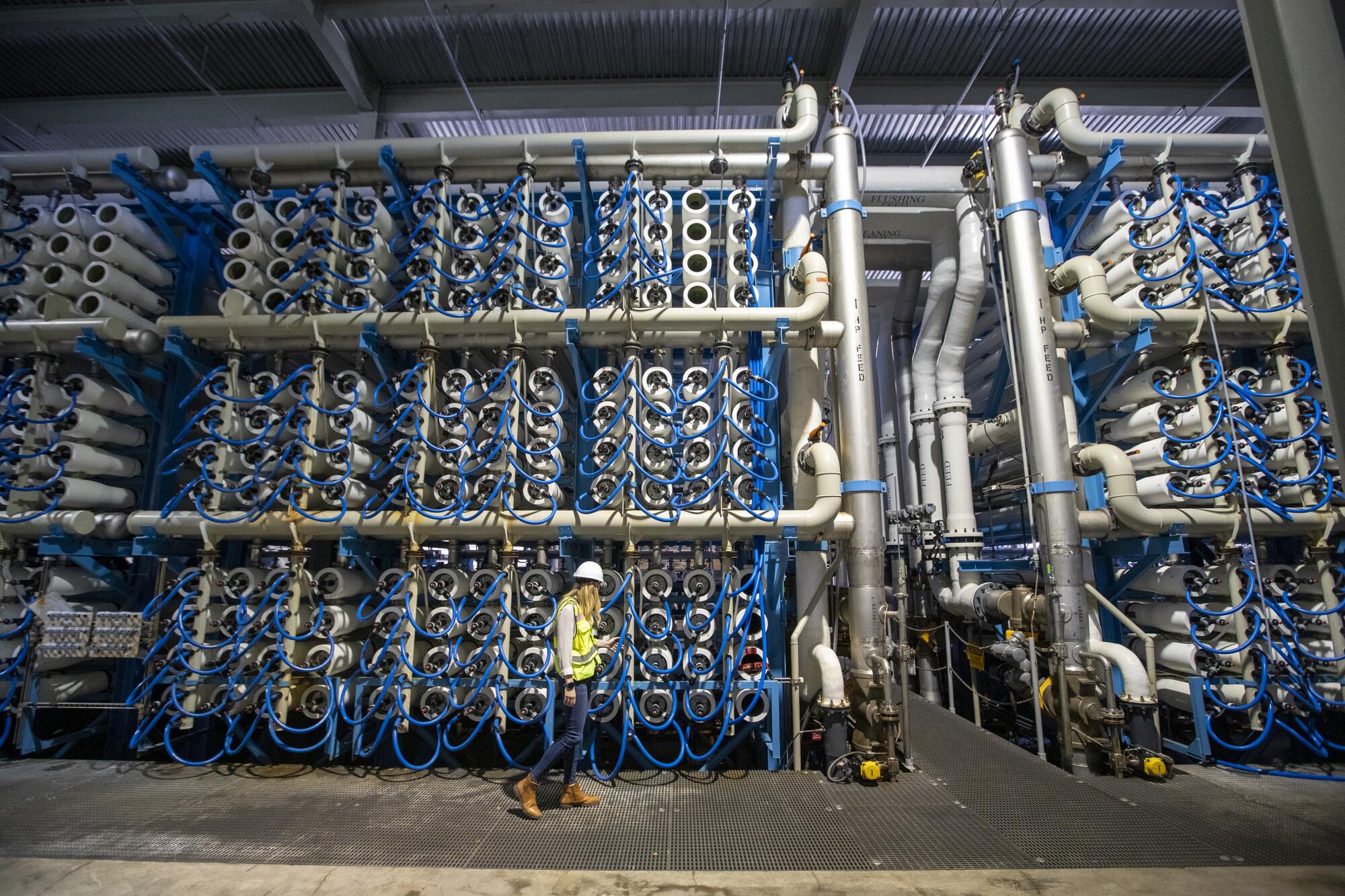
The Claude “Bud” Lewis Carlsbad Desalination Plant in Carlsbad in 2022.
(Allen J. Schaben / Los Angeles Times)
Carlsbad and Santa Barbara already have desalination plants. Water agencies in Orange County are also planning the Doheny Ocean Desalination Project.
But in 2022, the California Coastal Commission rejected a plan for one in Huntington Beach. Opponents argued that the water wasn’t needed, and raised concerns about high costs and environmental harm.
One question about OceanWell’s project is how much the water would cost.
Desalinated water from the Carlsbad plant is one reason people in San Diego County pay some of the highest water rates in the state.
If an offshore array were built for Las Virgenes and other agencies, OceanWell would own it and sell the water under contract. Initial estimates put the cost between $2,000 and $3,000 per acre-foot — significantly higher than other sources but still acceptable, Pedersen said.
As they consider a deal, Las Virgenes and six other agencies including the L.A. Department of Water and Power, the city of Burbank and Calleguas Municipal Water District, are forming a new entity called the Southern California Regional Water Authority, he said. They’re preparing for worsening droughts as climate change makes water from the Sacramento-San Joaquin River Delta and the Colorado River less reliable.
“For us, it’s all about diversifying water supply, being more climate resilient and not being in a situation where drought is going to have such a severe impact on our customers,” Pedersen said.
His agency, which depends almost entirely on imported water from the Delta via the State Water Project, serves more than 75,000 people in Agoura Hills, Calabasas, Hidden Hills, Westlake Village and surrounding areas.
During the last drought from 2020 to 2022, the district was under severe water restrictions and customers reduced usage nearly 40%.
As some residents fumed about the restrictions, they asked why managers of Las Virgenes weren’t taking a hard look at desalination. That led the agency to partner with OceanWell, Pedersen said.
If further tests prove successful, other sites along the California coast would be well-suited to the technology, Bergstrom said.

OceanWell’s trial last year involved lowering a 12-foot-long cylindrical prototype into Las Virgenes Reservoir near Westlake Village.
(Allen J. Schaben / Los Angeles Times)
“The potential is to make California water independent,” he said.
OceanWell recently signed an agreement with the water agency in Nice, France, to develop a smaller project.
“This could be a strategy used by coastal communities around the world,” Pedersen said. “And it’s exciting to do that here in California first.”
Some environmental advocates who have opposed desalination in the past are taking a wait-and-see approach.
“To the extent that you’re looking at emerging technologies that might prove feasible and be able to deliver the water with less harm and less cost, then great. Am I sold on it? Absolutely not,” said Bruce Reznik, executive director of the nonprofit group Los Angeles Waterkeeper.
He said he’s skeptical but he’d like to be proved wrong.
“We’ll see how it ends up penciling out in the end once we start to see some real results,” he said.