
Roki Sasaki, it turns out, can be quite the jokester.
In contrast to the 24-year-old right-hander’s more reserved demeanor on the mound and in postgame interviews, those who have gotten to know him during the past year and a half with the Dodgers have been treated to a different side of him.
“He talks a lot of trash,” Dodgers strength and conditioning coach Travis Smith told The Times this week, with a smile. “He’s not quiet at all.”
It’s easy to forget that Sasaki’s start Friday against the Angels will be only his 30th major-league appearance, regular season and postseason combined. And he only had four years of Nippon Professional Baseball experience before deciding to leave Japan, posting early and signing as an international amateur free agent last year, as Shohei Ohtani did in 2017.
Dodgers pitcher Roki Sasaki throws from the mound during a game against the Giants on May 11.
(Ronaldo Bolanos/Los Angeles Times)
It’s all still so new for a young player navigating a massive change on and off the field. So, the Dodgers expected growing pains. And after digging in their heels on the decision to let him work through those in the rotation to begin his sophomore season, they’ve been rewarded with a steadier version of Sasaki through the month of May (3.18 ERA), with still more room to grow, and stronger communication between the two sides.
“Obviously, there’s a lot of talent there,” manager Dave Roberts said. “There was a lot of expectation in getting him over here. But he still hasn’t pitched a whole lot of professional innings, and he’s still young.
“And so I do think that … we’re probably kind of over-expecting from Roki at an early stage. But for him, I wouldn’t say he would agree with our take and that’s a good thing from the athlete.”
For any player, transitioning from NPB to MLB requires countless adjustments, large and small. They range from the language and customs, to the schedule and travel, to the competition, to the baseball itself.
Sasaki, in a recent conversation with The Times through interpreter Kensuke Okubo, highlighted two differences that have felt especially jarring.
1. MLB teams want to know about every physical ailment their players are dealing with in real time.
Sasaki had first-hand experience with this one last season when he hurt his shoulder.
In Japan, if he were to flag discomfort in his shoulder, Sasaki said, the coaching staff’s response would be to point out that everyone’s dealing with aches and pains, so he doesn’t have to bring it up.
“But here, if something happens to your body, you have to tell them right away,” Sasaki said. “You don’t want to hide it.”
2. Americans put a high emphasis on confidence in their professional athletes.
Breaking down what went right in a bad outing (along with what went wrong) during postgame interviews has been new for Sasaki.
In Japan, after a rough start, he didn’t feel the need to talk about silver linings.
“Nobody tells you about the culture,” Sasaki said. “So I couldn’t really tell what you guys wanted in an interview, or when I talked to you guys. So, if I knew that kind of stuff earlier, then I could have reacted in a different way, so that I could make you guys understand a little more.”

Edgardo Henriquez, left, bumps fists with Roki Sasaki in the dugout at Dodger Stadium on May 14.
(Jayne Kamin-Oncea / Getty Images)
For guidance, he’s leaned on Smith and Will Ireton, the Dodgers’ director of Japanese player operations and strategy and Ohtani’s interpreter.
What’s the best advice he’s received from them?
“In Japan, being humble is … really important,” Sasaki said. “So whatever happens, and whatever I do, I’ve got to be humble. But here, once you make it, you have to be like, ‘I’m the one.’ It’s not showing off, but you don’t have to be really humble. You’ve got to show what you’ve got.”
Whether it’s the better results, or a shift in mindset, Sasaki has, indeed, seemed to carry himself with a touch more swagger lately.
“Guys love him,” Roberts said. “Guys really like Roki.”
In addition to teammates, Sasaki has grown close with the Dodgers bullpen catchers, Hamlet Marte and Francisco Herrera. He picked up some Spanish from Latino teammates in Japan that he uses to help bridge the language barrier.
“We’ve been trying to make him feel comfortable,” Herrera said. “So it’s a good thing that he’s opening up a lot.”
Marte, who catches Sasaki most often, can be spotted shouting to Sasaki in Japanese from across the clubhouse or running through dynamic stretches with him before side sessions. Anime has been an in with Sasaki for both of them, Herrera said.
Many of those now close to Sasaki are protective of the blossoming MLB starter — who endured the death of his father in a tsunami at a young age and has already weathered extensive outside criticism in his professional baseball career — as he navigates this new chapter.
“I told him at the very beginning,” Smith said, “you’ve just got to stick with us, be confident, and know who you are. And when you’re raising that trophy at the end of the year, I remember I told you this.”
Most of the league recognized Saski’s talent in the last years of his NPB career. Before the Dodgers signed him in January 2025, two-thirds of the teams in MLB sent in initial pitches, according to his agent Joel Wolfe. Because Sasaki hadn’t waited to enter regular free agency, as Yoshinobu Yamamoto had when he inked a 12-year contract worth $325 million with Dodgers, team finances didn’t limit the field.
Sasaki’s transition to MLB, however, was interrupted by what the Dodgers called a right shoulder impingement. Just eight starts into the season, he was sidelined, and pulled out of the usual cycle of in-game feedback followed by meetings and side work with the coaching staff.
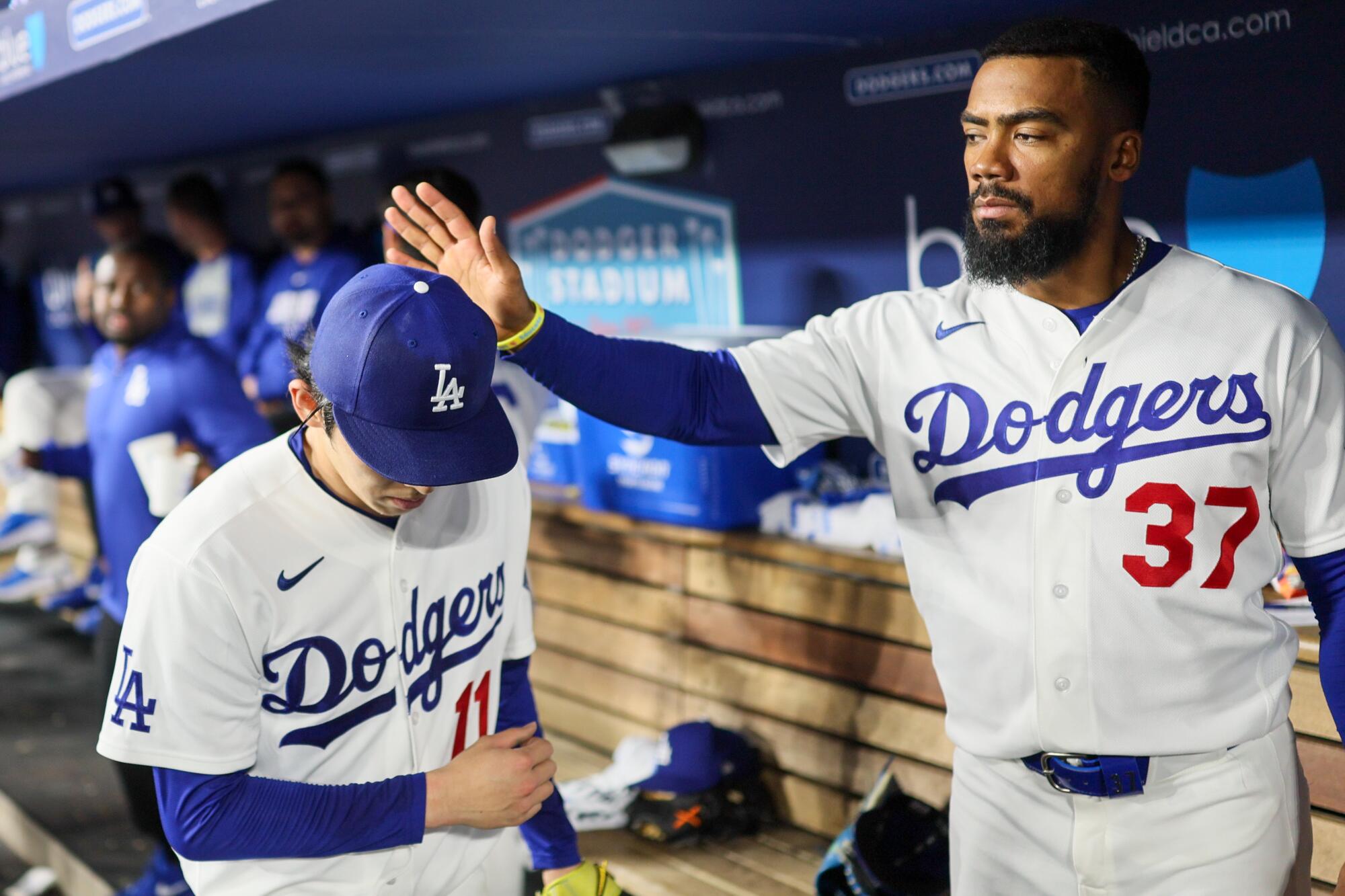
Dodgers left fielder Teoscar Hernández pats pitcher Roki Sasaki on the head in between innings at Dodger Stadium on May 11.
(Ronaldo Bolanos/Los Angeles Times)
“I don’t want to overplay it, but I don’t want to undersell it [either],” pitching coach Mark Prior said. “When you’re pitching and you’re in it, there’s back and forth, there’s more dialogue that happens about, ‘What is the game ultimately telling you?’ … Ultimately, for us to get everybody collectively in the right spot, it takes time of learning each other in those moments.”
They finally got again in late September and into the offseason, albeit in a different role.
Sasaki thrived coming out of the bullpen in the eighth and ninth innings, allowing just one earned run in nine postseason appearances.
“That helped me build a good relationship with the coaches,” Sasaki said.
Back in the rotation, Sasaki’s conversations with the coaching staff have shifted, compared to this time last year.
“This year, especially, I feel like we’re focusing on talking about game plan and sequencing, because I feel healthy right now,” Sasaki said. “Last year I got hurt, so I’m thinking about my mechanics, all that stuff. So this is a big difference right now.”
Roberts noticed the change long before Sasaki’s strong May performance.
“The trust on both sides has continued to get stronger,” Roberts said in early April. “And that’s understandable. That takes time. He and the pitching coaches are having much more dialogue. He’s expressing his thoughts, which has been great. And I think we’re seeing the benefits.”
Since then, the fruits of that evolving relationship have included a new, harder splitter, and even more recently, an uptick in fastball velocity.
And remember, it’s still just the beginning.