
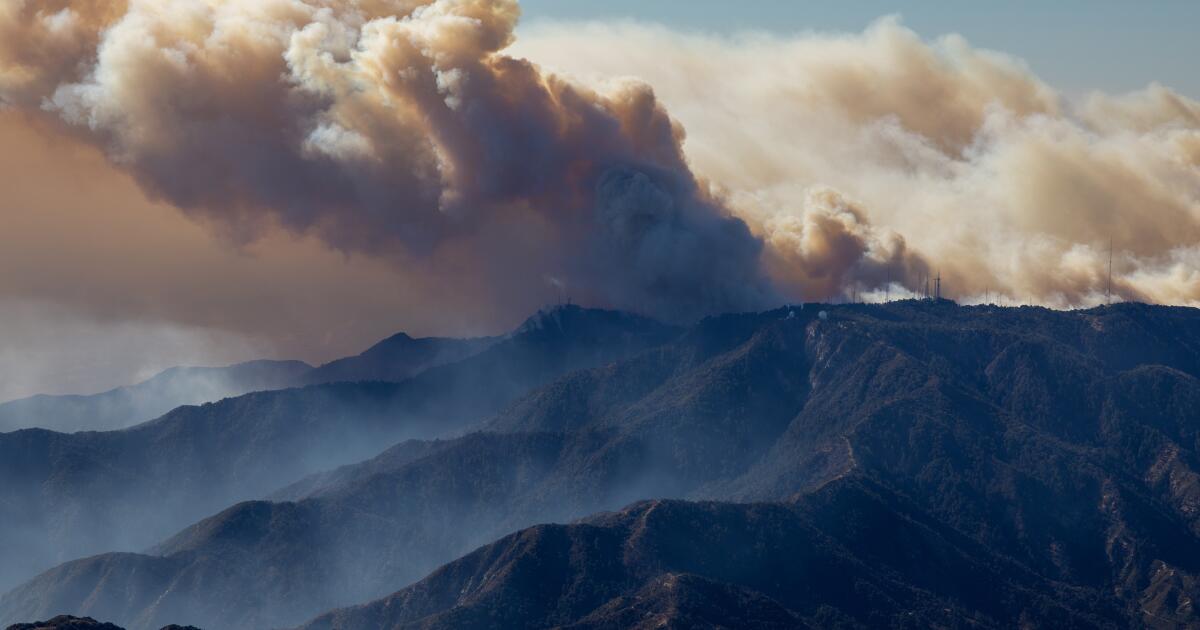
After the Eaton and Palisades fires devastated Southern California, a highly toxic metal stayed in the air much longer and probably traveled much farther than expected, according to a new study.
More than two months after the Eaton and Palisades fires were extinguished, researchers from UCLA and UC Davis detected elevated levels of hexavalent chromium — a potent carcinogen — in the burn areas, the paper in the journal Nature Communications Earth & Environment says. The chrome was in ultra-fine particles, more than 1,000 times smaller than width of a human hair, meaning it can more easily travel into the lungs, bloodstream and even cross cell membranes.
“When it’s in this nanoparticle form, it basically invades the barrier of our lungs, going into our blood and gets into our circulation,” said Michael Jerrett, environmental health professor at the UCLA Fielding School. “That raises the specter that you’ve got a lot of potentially toxic materials that are going directly into people’s circulation, and from there it can go to their brains, all their organ systems, and affect their metabolism and immunological responses.”
Computer modeling suggested that microscopic particles of hexavalent chromium traveled six to nine miles downwind of the fire-ravaged communities, potentially exposing 3.4 million people from Santa Monica to Pasadena to the highly toxic compound for several months.
The new findings add to concerns about the toxic fallout left behind by the most destructive wildfires in Southern California’s recent history. Hexavalent chromium, also known as chromium-6, is more than 500 times more carcinogenic than diesel exhaust. Inhaling even trace amounts over long periods can increase a person’s cancer risk.
The high concentrations dissipated after about eight months and no longer present a threat.
Researchers say a more detailed investigation is necessary to identify the source of the contamination and protect the public in the future.
“I’m an [air pollution] scientist. I have seen so much L.A. pollution data. I have never seen something like this in my life,” said Yifang Zhu, a UCLA environmental researcher and co-author. “This is something very unique. It’s still a puzzle. We each have our different hypotheses that we are trying to figure out.”
Starting in March 2025, UC Davis began driving an electric vehicle with highly specialized air sampling equipment to examine the size and composition of airborne particles in the Eaton and Palisades burn scars.
Researchers detected 16 airborne metals including lead, zinc, nickel and arsenic, Jarrett said.
The most surprising was tiny particles of hexavalent chromium. They measured it at an average concentration of 13.7 nanograms per cubic meter. That‘s about 137 times higher than the long-term exposure level for residential communities. However, it is well below the federal 8-hour benchmark for workers.
Because these levels lasted months, experts are still trying to figure out how the contaminants could affect the local cancer risk.
Based on local weather patterns, several communities downwind of the Palisades fire may have been exposed to high levels of hexavalent chromium, including Santa Monica, Beverly Hills and Culver City. Near the Eaton fire burn scar, hexavalent chromium particles probably settled over nearby Pasadena.
Scientists are still trying to determine where it came from.
A benign form of chromium (trivalent) is naturally found in some soils. Studies show that it can be converted to highly toxic hexavalent chromium by high temperatures.
Yet the communities most affected by the fires are not known to have a high concentration of chromium in the soil.
The 2 million liters of fire retardant dropped over the Eaton and Palisades fires could be a source, the study suggests.
The popular red-colored fire retardant released by firefighting airplanes and helicopters has traditionally contained high levels of chromium; it helps protect their aluminum tanks against rust. Although that suppressant was phased out and replaced with a formula with far less chromium, lab testing has confirmed that the heavy metal is still a key ingredient.
Researchers say the toxic chromium probably came from the myriad household items incinerated in the fires — paints, electronics, auto parts. When federal and private contractors removed fired debris from destroyed home sites, it could have been kicked up again.
The testing also showed that after a time, the chromium reverted back to nontoxic form.
“The first measurements that we took basically showed that somewhere around 90% of the total chromium, was chromium-6,” Jarrett said. “After another three months, it was down to about 50%, and then by six months it had returned to normal.”
Jarrett says fire in our future should make us rethink how we formulate household products.
“It seems like we want to start thinking about what should we be avoiding putting into consumer products when we know that if they go up in a very high intensity fire they’re likely to give off … chromium-3, would convert to chromium-6 and become highly toxic,” he said.
More recent air quality news
Major automakers are urging the EPA to delay tougher vehicle pollution standards for two years. They argue that lagging EV sales make the current timeline unworkable, Reuters transportation correspondent David Shepardson reports. But environmental groups argue the move will lead to more air pollution and worsened public health.
Environmental groups are questioning industry claims that garbage incinerators can virtually eliminate toxic PFAS “forever chemicals,” arguing the studies behind those claims rely on incomplete testing and unsupported assumptions. They say the facilities may still release PFAS and other harmful pollutants into nearby communities, while the waste industry maintains emissions remain at safe levels.
Meanwhile, as war rages on in the Middle East, the skies over Iran are filled with toxic fumes, Bloomberg climate reporter Laura Millan writes. Israeli military strikes on Iranian oil infrastructure have sparked days-long conflagrations, releasing a plume of noxious sulflur dioxide over an area roughly the size of Italy.
A few last things in climate news
Engineers are experimenting with a new offshore desalinization method in California. A startup company hopes to convert deep ocean water into drinking water at lower cost than coastal desalinization plants, according to L.A. Times water reporter Ian James. Engineers have been testing the technology off the coast of Malibu.
California air regulators recently approved major changes to the state’s cap-and-invest program, according to L.A. Times climate report Hayley Smith. The plan tightens emission limits while creating new incentives and free permits aimed at preventing refineries and manufacturers from leaving the state. However, environmental groups warned the changes could weaken pollution reductions and cut roughly $2 billion a year from funding for transit, affordable housing, clean water, and other climate programs.
In a closely -watched climate case, a federal appeals court upheld the dismissal of a lawsuit brought by 22 youth plaintiffs who challenged a slate of President Trump’s executive orders designed to boost fossil fuel production. The three-judge panel ruled the plaintiffs call for intervention would “require extensive judicial supervision of executive branch actions” on federal energy policy and the court was “not persuaded” the sought-after legal remedies were different than a previously failed case. While the U.S. Department of Justice and Republican-led states praised the decision, the plaintiffs and their attorneys sharply criticized the court for failing to address the active climate harms facing children.
This is the latest edition of Boiling Point, a newsletter about climate change and the environment in the American West. Sign up here to get it in your inbox. And listen to our Boiling Point podcast here.
For more air quality news, follow me at @_TonyBriscoe on X and LinkedIn.