
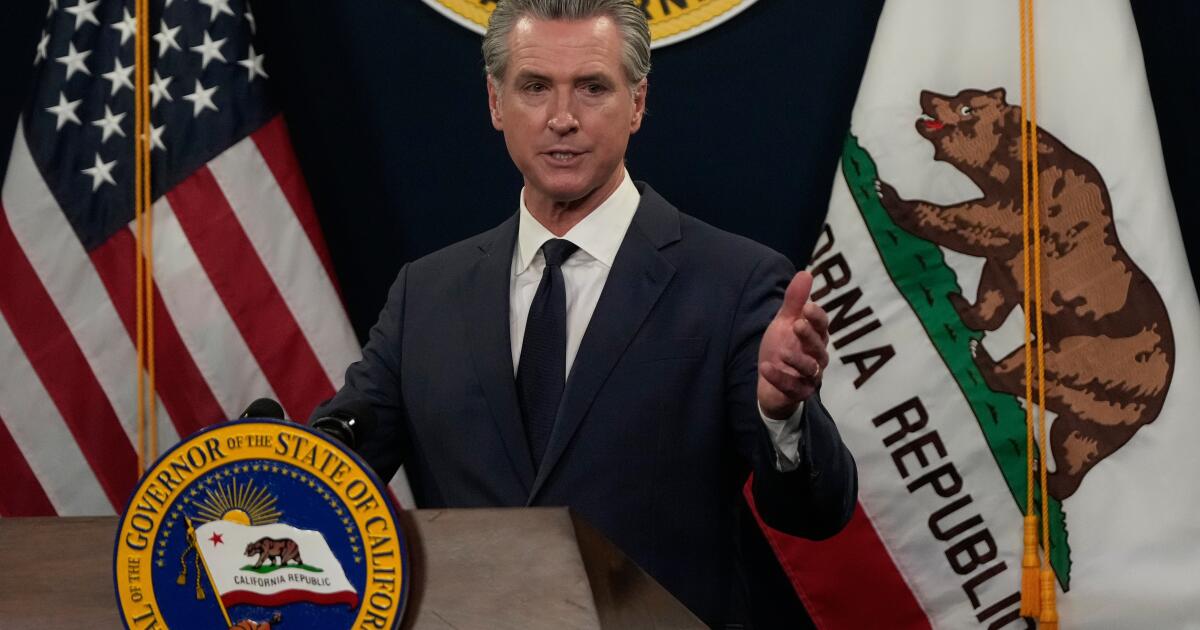
SACRAMENTO — Gov. Gavin Newsom’s revised $349.9-billion budget proposal largely relies on a tax windfall to erase California’s deficit over the next two fiscal years, allowing the Democratic governor to end his term with a surplus and say he’s providing a cushion for his successor.
The budget, which Newsom presented Thursday, showcases the governor’s desire to leave office without adopting new across-the-board taxes or dramatically curtailing his legacy-defining progressive programs as he considers a run for president in 2028.
An unexpected $16.8-billion increase in tax revenue, mostly attributed to the stock market success of artificial intelligence companies, appears to offer a lucky break for California’s 40th governor.
“We’re not going to walk away from this state and put the next Legislature and the next governor in a difficult spot,” Newsom said at a news conference in Sacramento. “We believe that the next governor and Legislature will be in a very good space.”
During an hourlong monologue, Newsom clicked a remote through 88 digital slides in his last budget presentation in eight years as governor, a time defined by unyielding financial uncertainty and one calamity after the next.
Facing more disasters than perhaps any of his recent predecessors, he has steered the state’s finances through the most destructive and deadliest wildfires in state history, the bankruptcy of its largest electricity provider and an unprecedented global pandemic. As revenue boomed, retracted and rose again, Newsom weathered the politics of a recall election, a friendly and a hostile White House and a position he seemed to relish as leader of a bastion of Democratic ideology for the nation.
The rap on Newsom among his conservative critics — often as a liberal spendthrift throwing money at California’s problems without solving them — seemed to inspire a defense of his record that he embedded into his delivery.
“With respect to those with California derangement syndrome, it’s time to update your talking points,” Newsom said. “It is time to tell the truth to the American people: California dominates. We have no peers.”
Newsom has expanded publicly funded healthcare to income-eligible undocumented immigrants, increased state-subsidized child-care slots and provided free meals for schoolchildren among a wishlist of progressive wins that he can tout to voters if he runs for president.
But the governor’s tendency to champion liberal causes and price tag of his agenda can clash with his interest in appearing fiscally prudent.
His budget proposal comes two weeks after the Legislative Analyst’s Office issued an analysis of state spending that said California could not afford to pay for existing services and the new programs that Newsom and Democratic lawmakers have enacted since he took office in 2019.
State spending has outpaced California’s strong revenue growth by about 10%, creating a perennial budget shortfall, defined as a structural deficit.
To balance the budget, Newsom’s spending proposal includes an unusual financial move.
The Democratic governor is recommending that the California Legislature put a portion of the revenue windfall into a temporary holding account that would be used to reduce an expected deficit in 2027-28.
The fund, called the Surplus Holding Account, would be activated for the first time since it was established in 2024.
The governor’s budget uses the extra revenue to reduce the structural deficit in future years, without cutting spending or increasing taxes enough to eliminate the problem altogether. If the AI boom ends, the structural deficit could remain.
“He says he’s leaving a balanced budget for the next governor,” said state Sen. Roger Niello (R-Fair Oaks), vice chair of the Senate Budget Committee. “He’s not.”
As a way to reduce ongoing spending, Niello said the state should audit programs enacted over the last several years and end those that aren’t working.
.
Along with plans to store money for future years, Newsom is also calling for some cuts to programs and new taxes on businesses.
His budget proposes limiting state corporate tax credits to $5 million, or 50% of a firm’s tax liability, whichever is greater. The cap would generate $850 million in additional state revenue next year and grow to $1.8 billion by 2029-30.
Combined with his other tax proposals, including a tax on digital prewritten software and a plan to recraft the distribution of proceeds from an existing tax on managed care organizations, the state would pull in an extra $3.6 billion next year and $5.1 billion the year after.
To reduce costs, Newsom is also proposing spending $3.7 billion less for state-sponsored healthcare for low-income Californians next year.
The governor is recommending increasing monthly premiums for some immigrants, including those with questionable or no legal status, to $50 and reinstating Medi-Cal asset limits for seniors and disabled adults, among other changes.
Supporters of California’s Medi-Cal expansion were dismayed by the proposed cuts.
“Some of the most harmful cuts are unfairly burdening those that are already struggling the most. Reinstituting the asset test will drive older adults and people with disabilities further into poverty, and lead to many of them getting kicked off care,” Diana Douglas, director of policy and legislative advocacy at Health Access California, said in a statement. “Imposing larger premiums on certain immigrant Californians widens the gap of those that can get care and those that can’t.”
Newsom repeatedly said President Trump’s policies have hurt California, detailing what he described as the the president’s impact on the cost of gas, airfare and energy and other critiques in more than a dozen slides.
One slide included a quote of Trump saying “I don’t think about Americans’ financial situation” this week. Another replaced the main characters of the movie “Dumb and Dumber” with Trump and U.S. Secretary of the Treasury Scott Bessent.
Newsom said H.R. 1 will leave 1.3 million Californians without access to healthcare. His budget presentation also came one day after Vice President JD Vance declared that the Trump administration is deferring $1.3 billion in Medicaid reimbursements to California.
Senate Minority Leader Brian Jones (R-Santee) dismissed the assertion that Trump is to blame for much of California’s budgetary woes.
“He’s been governor for seven and a half years,” Jones said of Newsom. “Every single year, it’s the same thing over and over. He presents a smoke-and-mirrors budget and then always blames somebody else for the shortfalls.”
Without a long-term plan to pay for many of the progressive policies he’s adopted, Newsom acknowledged that they might not continue under whoever replaces him as governor next year, but said he didn’t see that happening.
“I hope we can continue to make the kind of investments in healthcare,” Newsom said. “I hope we continue to transform the mental health system. I hope we can continue to make the investments we’ve made in housing and homelessness.”
The governor said he worked with partners in the Legislature and interest groups to accomplish his agenda. He said he’s also aware of the cost.
“We were very indulgent,” Newsom said. “I mean, I’m not naive about the investments we made. I’m also proud. I want to defend them.”
Newsom’s budget largely resists new major spending commitments, but supports some new programs.
His plan includes providing $300 million to help low-income Californians keep $0 monthly premiums on healthcare coverage through the Affordable Care Act in response to cuts by the federal government, as well as $100 million to help wildfire victims afford construction loans to rebuild their homes. Two days before Mother’s Day, Newsom also introduced a plan to provide 400 free diapers for California newborns at select hospitals beginning this summer.
Times staff writer Katie King contributed to this report.