
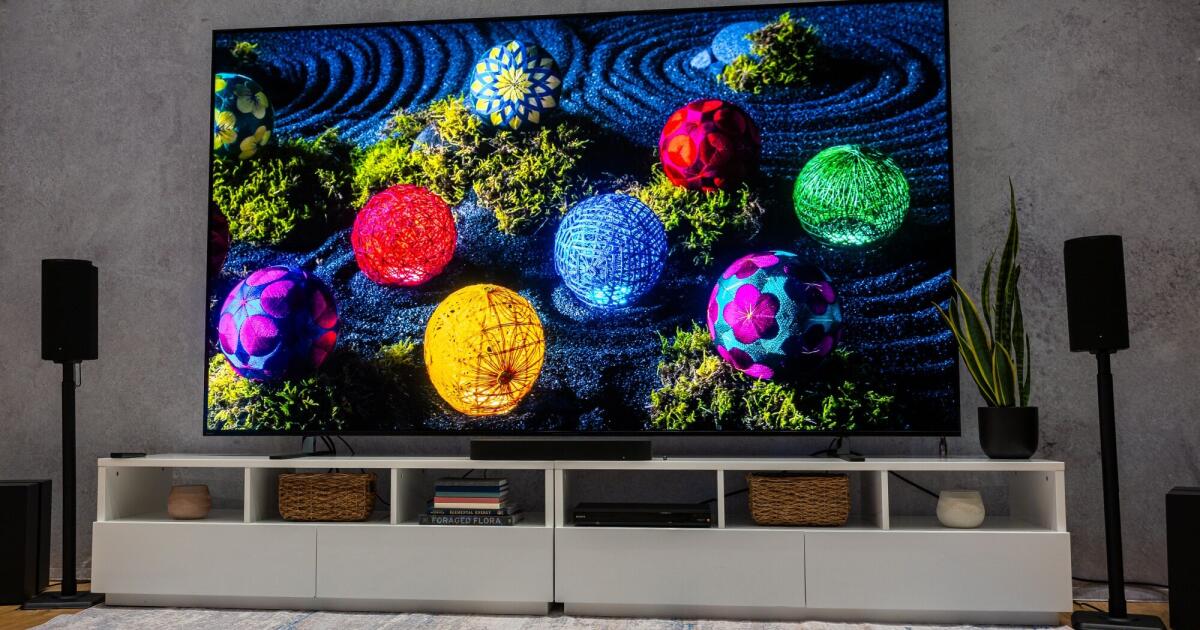
Sony Group Corp. unveiled two high-end televisions, likely the Japanese company’s last premium sets before its storied home theater business merges with TCL Electronics Holdings Ltd. next year.
The Bravia 9 II and Bravia 7 II start at $3,600 and $1,600, respectively, and are being offered in a wide range of sizes, according to a statement on Wednesday. Sony also introduced the Bravia Theater Trio, a $2,200 surround sound speaker system that competes with Sonos Inc., Samsung Electronics Co., and other makers of premium soundbars. All of Sony’s new products are available for preorder and will ship in June.
TCL agreed earlier this year to pay 75.4 billion yen ($473 million) for a 51% stake in a new joint venture that will absorb Sony’s home entertainment unit, including Bravia televisions. The entity will formally launch in April 2027, making TVs under Sony and Bravia branding while integrating TCL’s display technology.
Sony televisions have long been renowned for their proprietary image processing, which often does a better job than competing sets at matching a filmmaker’s original creative intent, down to the smallest technical details. But it’s unclear whether this signature ingredient will carry forward, and some home theater enthusiasts could be tempted to buy what they may perceive as the last true Sony TVs to come to market.
“Sony’s high-quality picture and sound technologies, and design philosophies, are intended to remain an important foundation” to future TVs from the joint company, said a spokesperson in an emailed statement. “The new company intends to integrate the respective strengths of both parties in the most effective manner.”
Though the Bravia 9 II starts at $3,600 for a 65-inch set, the price climbs as high as $31,000 for a massive 115-inch model. It has an LCD panel featuring what Sony calls “True RGB” technology, which uses tiny, individually controlled red, green and blue light-emitting diodes, or LEDs, to produce better color purity and brightness than the company’s past TVs. Viewing angles are also more consistent, letting people seated off to the side still enjoy a vivid image.
RGB TVs are this year’s hot trend, with similar products on offer from TCL, Samsung, LG Electronics Inc. and other brands like Hisense Group Holdings Co. As their high prices make clear, these models are aimed at home theater aficionados who demand the very best picture. Most consumers would be better off spending considerably less on cheaper LCD sets, like those with more conventional Mini LED backlighting, or an OLED model, short for organic light-emitting diode, which can still produce deeper blacks.
The advantages of True RGB are most evident in side-by-side tests, where colors have added pop and richer vibrance. Sony’s latest system can also keep the Bravia 9 II easily visible in harsh lighting environments and sunny living rooms. In addition, the higher-end model has an anti-glare panel to help further combat reflections.
As an added design flourish, the Bravia 9 II features a “Mirage Stand” with a transparent section that’s meant to give the TV a floating-in-air appearance.
Like other recent Bravia models, the 9 II runs Alphabet Inc.’s Google TV operating system and lets users interact with the search giant’s Gemini artificial intelligence assistant using their voice.
The less expensive Bravia 7 II line starts at 50 inches, and tops out at $9,000 for a 98-inch screen. It shares the same underlying True RGB tech as the top-tier model, but lacks the anti-glare panel treatment and Mirage Stand.
Sony’s comprehensive new surround system pairs a soundbar as the center channel with dedicated front-left and front-right speakers. This type of configuration is rare: Most soundbar systems only support rear surround speakers and a subwoofer. But Sony’s approach should provide a wider soundstage than Sonos and other competitors with less reliance on virtualization and fooling your ears into thinking you’re hearing sound coming from all sides. It should also make voices and dialogue easier to understand.
Welch writes for Bloomberg.