
It is, by any measure, the year of Catherine Opie.
In her downtown Los Angeles studio, Opie is preparing for one of the most visible stretches of her career, with work appearing simultaneously across Europe and Los Angeles. This includes a career-spanning survey at London’s National Portrait Gallery that will travel to Edinburgh’s Royal Scottish Academy, as well as exhibitions in Kassel, Germany, and Trondheim, Norway. Closer to home, a new exhibit, “Holding Blue,” opens May 28 at Regen Projects.
Opie’s photos will also appear this summer in group shows at several other L.A. art venues, including the Autry Museum of the American West, Hauser & Wirth, and David Zwirner, in exhibits featuring photographs that trace a practice moving fluidly between intimate portraiture, civic history and the natural world. Her work is also in the permanent collection of the Marciano Art Foundation.
“I don’t think that many artists have five really large shows in one year,” Opie, 65, said during a recent interview.
Sitting next to miniature mock-ups of the exhibitions, Opie noted that her longtime gallerist, Shaun Caley Regen, has christened this the “Catherine Opie World Tour 2026,” complete with T-shirts.
Opie’s exhibition, “Holding Blue,” at Regen Projects centers on a series of Norwegian mountain landscapes shot over 20 days in early 2024.
(Allen J. Schaben/Los Angeles Times)
Opie initially came to the attention of the art world in the 1990s for documenting her queer community and was declared the “American Photographer” at her Guggenheim retrospective in 2008. At Regen Projects, however, her work takes a quiet, introspective form.
“Holding Blue” centers on a series of Norwegian mountain landscapes shot over 20 days in early 2024. Opie became captivated by the Arctic light during her first trip to the region more than a decade ago, and she long hoped to photograph Norway’s famous “Blue Mountains.” The opportunity arose after she retired from UCLA, where she had served as chair of the art department and also taught photography for more than 20 years.
“I thought it would be really great to bring the blue mountains [to Los Angeles], not only to remind us of what we mourn for our water loss in the Sierras, but also as a meditation for us as a city in … mourning,” she said, referencing both California’s prolonged drought and the 2025 wildfires.
The 44 images at Regen, accompanied by nine ceramic sculptures, reflect on the mountain’s changing light and environmental vulnerability, continuing Opie’s longstanding interest in how photographs bear witness.
In Norway, Opie hoped to explore — and contribute to — the long history of blue in art, from Pablo Picasso’s Blue Period to Yves Klein’s monochromes and Derek Jarman’s elegiac film “Blue.” The resulting images capture mountains and fjords dissolving into sky, rendered in the deep azure light of the Arctic Circle. The mountain photos will also be on display at the PoMo museum in Trondheim.
When the Eaton fire exploded early last year, the images hung in Opie’s studio awaiting final edits. They took on added resonance when Opie ceded the space to five friends displaced by the flames, offering food, shelter and a place to regroup.
“I gave [the photos] first to my friends of Altadena,” she said, adding that she was now sharing them with the larger community. Opie noted that the title “Holding Blue” refers to both the physical presence of the mountains and the emotional responses they evoke.
Reflecting on the busy year, Opie said she feels “incredibly moved and honored that I am actually an artist [who] can make a difference in the world for young people who are scared.” The environmental vulnerability embedded in the landscapes echoes fears that Opie sees spreading as political hostility intensifies nationally.
This cyclic trend is not new to Opie, whose best-known works, particularly from the 1990s, brought unprecedented visibility to communities that contemporary photography at the time rarely focused on.
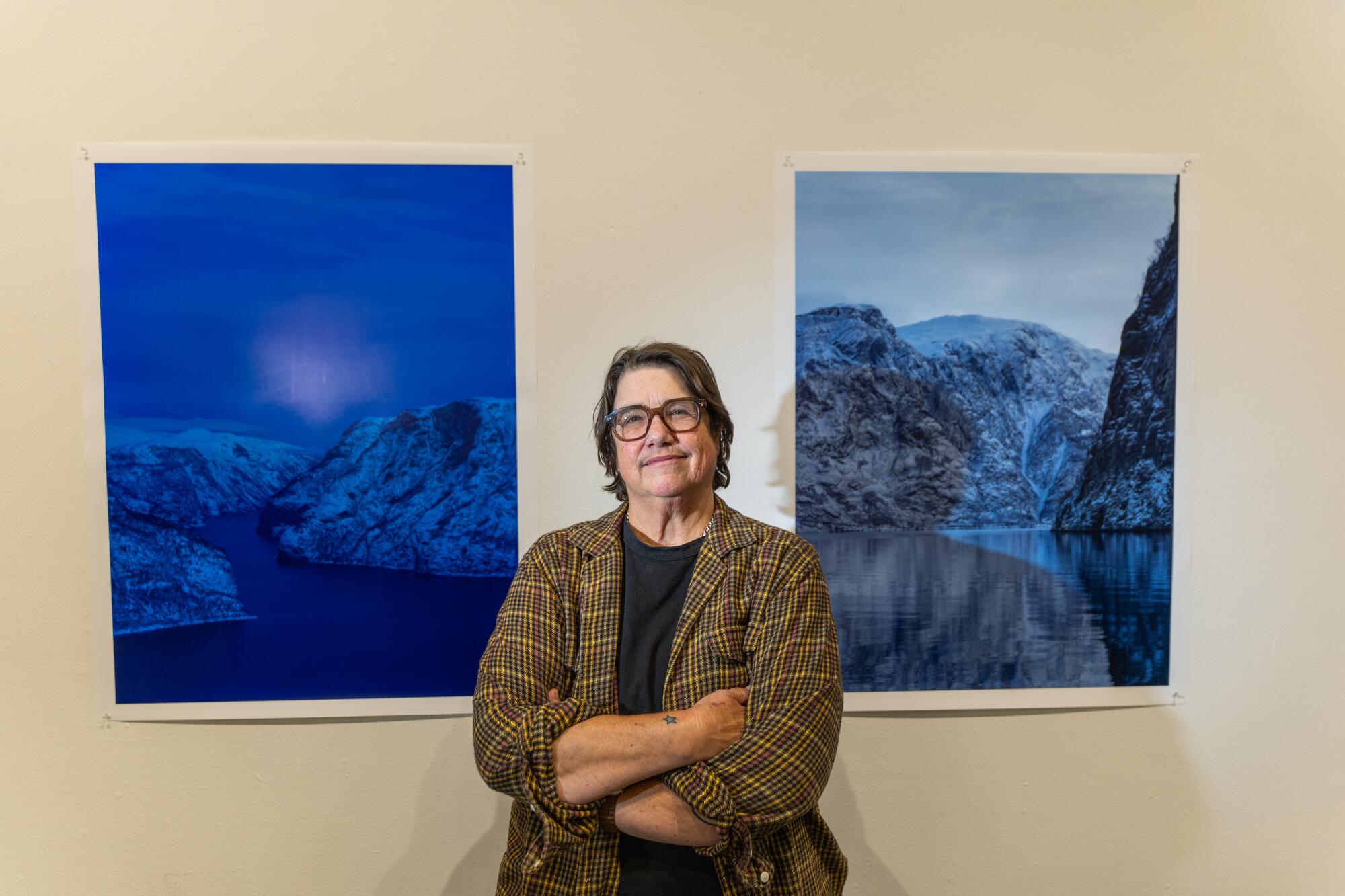
Photographer Catherine Opie at her studio at the Brewery Artist Lofts. She is preparing for one of the most visible stretches of her career, with work appearing simultaneously across Europe and Los Angeles, including a new exhibit, “Holding Blue,” which opens May 28 at Regen Projects.
(Allen J. Schaben / Los Angeles Times)
“The LGBTQ community is very much still being harassed … homophobia and transphobia are at the highest that it has been since the ’80s, [during the] AIDS crisis,” she said, at one point tearing up as she spoke about the recent suicides of two friends.
For Regen, founder of Regen Projects, Opie’s ability to move across subjects has long defined her practice. She recalled first meeting the artist in her Koreatown apartment in the early 1990s when she saw portraits that were featured in Opie’s seminal series “Being and Having.”
“There’s no way, when I first sat there [that I could imagine] what a range she had as an artist,” Regen said. “How she could go between the most … formal, exquisitely beautiful work to almost street photography.”
That range is evident in Opie’s contributions to “California Light and Space (The 21st Century Version)” opening at David Zwirner on June 4, and organized by former Museum of Contemporary Art chief curator Helen Molesworth.
Opie photographed images in that show from the balcony of her Hollywood high-rise. The photos transform the city’s atmosphere into fields of luminous color — the Hollywood Roosevelt’s sign silhouetted against saturated red and yellow skies, or the moon suspended in darkness. Molesworth said Opie’s work helps articulate the show’s thesis of framing today’s artists’ exploration of their environment — utilizing light and space to dismantle linear perspective — similar to what artists such as James Turrell and Robert Irwin did 50 years ago.
“Cathy knows that water and air meet and form a horizon line, but she’s taking a picture in which [the line] is gone,” Molesworth said, describing Opie’s technique as “magic.”
For Molesworth, a longtime friend of Opie’s, the artist’s work occupies a space between photography and painting — images whose scale and atmosphere reshape how viewers experience light, landscape, and the built environment.
“Cathy never gave up on beauty, even though beauty is a very difficult and problematic concept,” Molesworth said.

“Cathy never gave up on beauty, even though beauty is a very difficult and problematic concept,” said curator Helen Molesworth of photographer Catherine Opie.
(Allen J. Schaben/Los Angeles Times)
Opie plans to return to her long-running “American Cities” series, photographing Washington, D.C., this summer. Since 1997, she’s periodically turned her camera on urban landscapes, including Los Angeles and Chicago, using architecture and public space to reflect on broader social and political issues. This time, she wants to capture the capital before President Trump’s proposals to reshape its monumental core begin to transform the district’s visual and symbolic landscape.
Opie’s interest in photography as a vehicle for healing extends beyond gallery exhibitions. She is collaborating with architect Katy Barkan in designing four meditation pavilions that she hopes UCLA will erect for the 2028 Los Angeles Olympics. Conceived as spaces of respite for athletes — whom Opie believes are more often commodified than nurtured — the pavilions will incorporate photos by the artist that reflect California’s “fragile environment.”
The spaces are intended as places of contemplation and rejuvenation for the athletes. Although Opie could use some of that herself, she shows no signs of slowing down. Despite bouts of grief and political anxiety, she remains resolute.
“I’ll cry in the day and then get back up and ride into the sunset.”
For Opie, endurance remains its own form of hope.
Holding Blue
Where: Regen Projects, 6750 Santa Monica Blvd., Los Angeles
When: May 28-July 3
California Light and Space (The 21st Century version)
Where: David Zwirner, 606 N Western Ave., Los Angeles
When: June 4 to August 1