
California’s Route 395 is an underappreciated state treasure, bordered on both sides by towering mountains and measured not by mile markers but by roadside destinations: a fresh jerky store, the portal to the highest peak in the Lower 48 states, a Dutch-style bakery and a popular ski resort plopped on top of an active volcano.
Among 395’s do-not-miss destinations is the Manzanar National Historic Site, just outside the tiny town of Independence.
The U.S. government converted the abandoned town of Manzanar at the start of World War II into a camp to incarcerate more than 10,000 Japanese Americans and Japanese immigrants. After the Japanese attack on Pearl Harbor, they were deemed a threat to the war effort. Without due process, everyone of Japanese ancestry on the West Coast was forced to abandon (or sell, usually at a significant loss) their homes, farms and businesses before being put in camps like Manzanar.
The collection of ramshackle buildings, rusty pipes, barren foundations, guard towers and a weathered cemetery tell a dark chapter in the nation’s history.
I stopped by Manzanar because I had read the Trump administration had directed the National Park Service to scrub signs and displays at national parks and historic sites of anything that might be considered too negative about America’s past.
Can you whitewash the message of Manzanar?
As I walked through the camp’s rough-hewn barracks and read the displays, I noticed no attempt to rewrite Manzanar’s appalling story. To confirm what I was seeing, I called Bruce Embrey, co-chair of the Manzanar Committee, a nonprofit that was formed, in part, to establish the site as a historic landmark.
Embrey agreed with my assessment, saying there’s “nothing specific that I’ve noticed that’s been altered.”
But he said something new has been added at the visitor center: a sign emblazoned with a QR code and a message, asking visitors to report “any signs or other information that are negative about past or living Americans.”
Reducing access to the camp
Embrey pointed out another change that has “stifled the impact” of the site: The visitor center now opens only four days a week. As recently as 2022, it was open seven days a week.
The National Park Service confirmed in an email that the park’s content had not changed and that visitor center hours were cut in March 2024 (during the Biden administration) “to best balance staff and other park needs.”
Dennis Arguelles, Southern California director for the National Parks Conservation Assn., agreed that the cuts to the operating hours mean the “public will be missing an opportunity to hear the story of Manzanar.”
Statistics seem to bear that out: In 2024, Manzanar drew 93,854 visitors, down about 11% from the 105,416 visitors before the operating hours were shortened, according to National Park Service data.
A sad trend, to be sure, but Arguelles predicts an even bleaker future for the site. The Trump administration’s budget for 2027 calls for a nearly 25% cut to park spending. Those cuts will probably mean eliminating interpretive programs for schoolchildren and “a backlog of maintenance that hasn’t been done,” he said.
Ordinary people and great victories
For Embrey, the cuts at Manzanar are personal. His mother, Sue Kunitomi Embrey, was sent to Manzanar in 1942 at the age of 19, along with her mother and six siblings. Years after Manzanar — and nine other incarceration camps — was closed, Sue Embrey led an effort to have it declared a historic site. She also took part in annual pilgrimages to the camp to bring attention to what took place on that flat, desolate patch of land.
Bruce Embrey attended the latest pilgrimage in April and spoke to nearly 1,500 people about Manzanar and his mother, who passed away 20 years ago.
“The founders of our committee, including my mother, Sue Kunitomi Embry, knew Manzanar could be transformed from a site of oppression into a beacon for democracy,” he told the crowd. “Today, Manzanar can prove that ordinary people can win great victories despite great odds.”
Today’s top stories
A pedestrian passes by a restaurant in downtown Arcadia on Tuesday.
(Christina House / Los Angeles Times)
A crisis in ‘Chinese Beverly Hills’
- Arcadia Mayor Eileen Wang stepped down after entering a plea agreement, admitting to acting as an illegal Chinese foreign agent and operating a propaganda website targeting Chinese Americans from 2020 to 2022.
- The charges have Arcadia’s predominantly Asian American community worried about potential anti-Asian backlash, though city officials emphasize that Wang’s alleged misconduct occurred before her 2022 election to the City Council.
Another Californian was exposed to hantavirus
- An expedition cruise ship capable of exploring remote Antarctic regions became the epicenter of the first deadly hantavirus outbreak at sea, killing three passengers of the MV Hondius.
- Health officials have identified another California resident who was exposed to the deadly hantavirus strain that spread on the Dutch cruise ship.
- This brings the total count of exposed Golden State residents to five, all of whom are currently asymptomatic, according to the California Department of Public Health.
Heavier storms and longer dry spells are drying California and the West
- Rainfall across much of California and the West has become more clustered in heavier storms, with longer dry spells in between.
- The effect is a drying out, researchers found in a new study. Scientists predict this will happen more because of climate change.
The LGBTQ+ nightlife king running for L.A. mayor
- Mayoral candidate Bryant Acosta is a nightlife promoter and son of Mexican immigrants who has a “hand on the pulse of the city.”
- After Zohran Mamdani won the New York mayoral race in November of last year, Acosta felt like his hometown was in need of a similar shake-up.
What else is going on
Commentary and opinions
This morning’s must-read
Another must-read
For your downtime

A series of seven digital billboards promoting peace will be placed throughout the city as part of the Broad museum’s upcoming exhibition, “Yoko Ono: Music of the Mind.”
(Nick Jaicomo. © Yoko Ono)
Going out
Staying in
A question for you: With three new stations open, will you ride L.A. Metro’s D Line?
Justin says, “Very excited to see this and rode it on opening day. I think this will be a big improvement for the city and hit a lot of attractions. I already rode the D line to go to work on weekdays, so it’s great that it will now go to more places than before.”
Email us at essentialcalifornia@latimes.com, and your response might appear in the newsletter this week.
And finally … from our archives
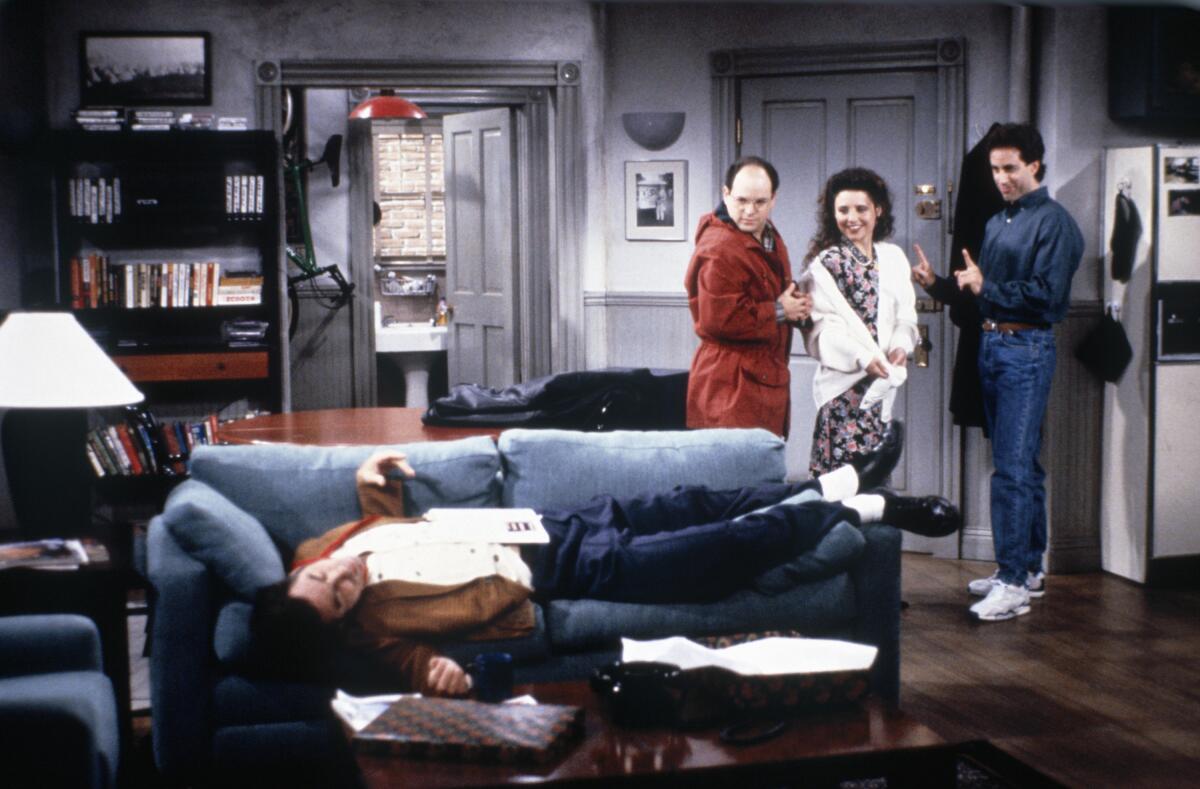
On May 14, 1998, the series finale of “Seinfeld” aired. The Times’ former television critic Howard Rosenberg wrote in his final “Seinfeld” column that the show “had its moments, and its concept was clever enough. But it delivered many fewer yucks than yadas.”
Have a great day, from the Essential California team
Jim Rainey, staff reporter
Hugo Martín, assistant editor, fast break desk
Kevinisha Walker, multiplatform editor
Andrew Campa, weekend writer
Karim Doumar, head of newsletters
How can we make this newsletter more useful? Send comments to essentialcalifornia@latimes.com. Check our top stories, topics and the latest articles on latimes.com.