
Inside the long-shuttered St. Vincent Medical Center on the outskirts of downtown Los Angeles, bulletin boards, furniture and other remnants of a once active hospital remain, frozen in time. But a few flights up, art has taken over.
Bulky surgical lights loom over a vacant room transformed into a life-size version of Twister, complete with brightly colored decals resembling the familiar red, yellow, green and blue game mat. Down the hall, ceramic eggs cover the walls while a giant yolk rests atop a mattress, turning a hospital bed into a commentary on fragility and birth. On the same floor, a neon bed is bathed in red light. Two floors below, IV bags filled with grasses, fungus and a wasp nest hang from the ceiling as part of a meditation on the healing aspects of the environment.
Javiera Estrada’s “What Happened to Twister,” in the Joy Department at the “Hospital of Emotions” at St. Vincent Medical Center. The immersive exhibition features 70 artists and more than 80 rooms.
(Carlin Stiehl / For The Times)
Welcome to the “Hospital of Emotions.” This latest entry in Los Angeles’ growing immersive art scene temporarily occupies four floors of the former hospital in the Westlake district and runs May 27 through July 31. The 45,000-square-foot exhibition brings together the work of more than 70 artists organized into emotional departments including grief, fear, hope, joy and sadness.
Unlike many selfie-friendly pop-ups, however, the exhibit is unfolding inside a building preparing for a very different second act: In 2028, it will reopen as the anchor of the St. Vincent Behavioral Health Campus, providing addiction treatment, mental health services, recuperative care, interim housing and permanent supportive housing.

Michael Keppler’s work in the Sadness Department at the “Hospital of Emotions” at St. Vincent Medical Center.
(Carlin Stiehl / For The Times)
This latest incarnation is in keeping with the building’s long history in the community. St. Vincent’s was founded in 1856 by the Daughters of Charity as L.A.’s first hospital. It closed due to bankruptcy in 2020 before serving as a temporary COVID-19 treatment center. The facility was acquired that year by Dr. Patrick Soon-Shiong, owner of The Times and head of the global health firm NantWorks, who recently sold the 7.7-acre campus to a private investment group co-owned by Shay Yadin.
“The hospital is in a transitional period,” said the event’s producer Oshri Elmorich, a singer and founder of the hospitality group Royva, during a recent tour of the site. “We thought, why don’t we bring in artists and activate the space in between? This was a place of physical care — now we’re bringing artists that create an emotional care journey accessible to everybody.”
Tickets cost between $42 and $58, with a portion of the proceeds benefiting the behavioral center’s nonprofit administrative organization, according to Yadin.

Melan Allen’s “The Eggsibition” at the “Hospital of Emotions” at St. Vincent Medical Center.
(Carlin Stiehl / For The Times)
Installations, complete with blinking lights, video and music, now occupy former intake, surgery and recovery floors. Elmorich says roughly 2,000 applications were received through an open call before the selection of the multidisciplinary participants, including graffiti artists, photographers, set designers and art directors. Many of the artists modified their concepts specifically to the hospital rooms they were assigned, incorporating showers, beds and medical equipment into the final installations.
“The selection process was much less about medium or career stage and more about emotional clarity and the ability to create an experience people can physically feel when they enter a room,” curator Yaara Sachs wrote in an email. Sachs, whose work is also featured in the exhibit, has staged similar experiential art exhibits in Israel through her company House of Art & Dreams.
Los Angeles multimedia artist Javiera Estrada’s “What Happened To Twister” transforms a hospital room in the Joy Department into a life-size version of the iconic game, complete with mannequins strewn across the floor, on chairs and diving head first from the bed.
“What a cool opportunity to be able to enter an empty hospital and transform what is typically a place of intensity — [with feelings of] pain, maybe joy,” Estrada said. “There are a lot of emotions that go on in a hospital.” Estrada sees Twister as a “metaphor for life” — rising, falling and getting back on your feet.

Moran Sanderovich’s “Her Hair” in the Compassion Department at the Ho”Hospital of Emotions,” an immersive art exhibit at St. Vincent Medical Center.
(Carlin Stiehl / For The Times)
Other artists approached the space through the lens of trauma and healing. In the Compassion Department, Berlin-based artist Moran Sanderovich adapted her installation after being assigned an accessible-shower room instead of a standard hospital room. “Her Hair” explores disability, vulnerability and the body through the use of crutches and walkers assembled into a beastly figure awash in fake pink locks.
In the Resilience Department, visitors can don headphones to listen to sounds recorded by Canada-based artist Margüi during an epileptic seizure for a piece titled “Unbreakable.” Suggesting emergence rather than collapse, a winged metal woman rises from a hospital bed, bathed in multicolored light projected across the walls, while translucent metallic fragments dangle overhead. “The whole world was broken into pieces,” Margüi said of her installation. “That’s what I lived.”

Tara Rey’s work in the Sadness Department at the “Hospital of Emotions” at St. Vincent Medical Center.
(Carlin Stiehl / For The Times)
A hospital in transition
Yadin, Elmorich and Sachs had discussed staging immersive art projects together for years before plans finally aligned with the hospital’s acquisition.
Yadin said he hopes the exhibition also helps shift public perceptions around homelessness and mental health.
“It’s not just a commercial art exhibit — there’s nothing wrong with that — but it’s not the Museum of Ice Cream,” Yadin said, referring to the Instagram-friendly pop-up experience rumored to be reopening in L.A. this year.
Yadin said the Hospital of Emotions may extend beyond July. He sees the project as both an arts destination and a way to reintroduce the city to the storied building.
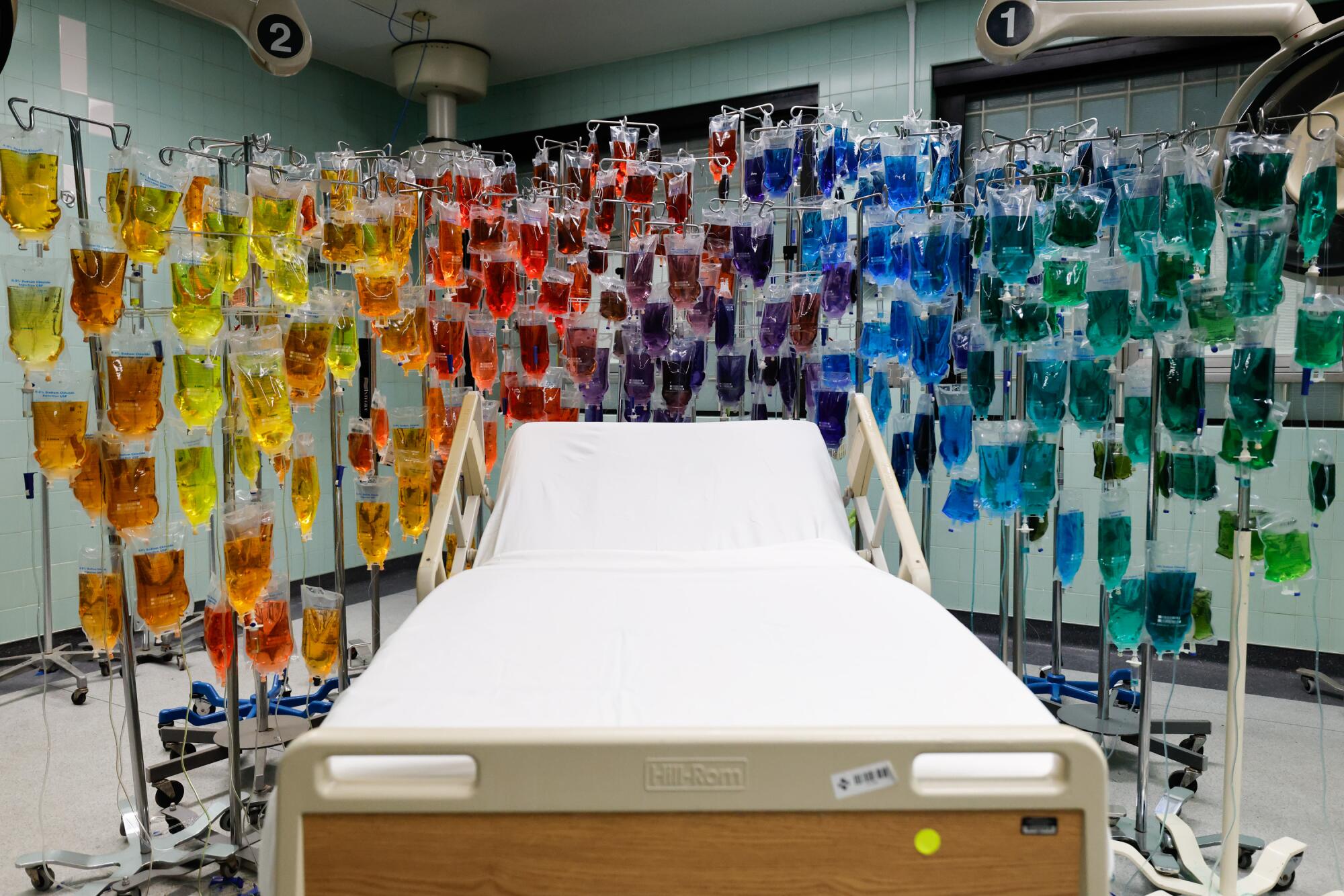
Yaara Sachs’ work in the Joy Department at the “Hospital of Emotions” at St. Vincent Medical Center near downtown L.A.
(Carlin Stiehl / For The Times)
The main hospital campus housing “Hospital of Emotions” on West 3rd Street is expected to open as a behavioral facility by the 2028 Olympics. Yadin and his firm, St. Vincent Behavioral Health Campus LLC, estimate the redevelopment will cost roughly $300 million and create more than 800 beds across a multiphase behavioral health and housing campus that will eventually include interim housing, recuperative care and addiction treatment programs. One standalone building, Yadin said, is planned as a future arts, community and workforce training center.

Royva x Krisia KIKI Powell’s work in the Joy Department at the “Hospital of Emotions” at St. Vincent Medical Center.
(Carlin Stiehl / For The Times)
In June, a facility with 205 interim housing beds operated by Exodus Recovery is scheduled to open on nearby Lake Street. That will be followed next year by 172 units of permanent supportive housing on Alvarado Street in partnership with the nonprofit the People Concern, which also contributed an installation to the exhibit called “The Remembrance Tree.” The nine-foot papier-mâché sculpture is covered with butterflies bearing the names of unhoused people who have died, and was created by members of the organization’s Studio 526 Creative Space on Skid Row.
The People Concern’s director of member services, Alice Corona, expressed hope that a high-visibility project like “Hospital of Emotions” will help destigmatize homelessness while bringing wider recognition to the artists involved. She said that members of the studio crave exposure for their work.
Invisible trauma — and recovery through art — is a prominent throughline of the exhibition.

Paal Anand’s “The Ward That Never Closed” in the Fear Department at the “Hospital of Emotions” at St. Vincent Medical Center.
(Carlin Stiehl / For The Times)
The aftermath of an IED explosion is re-created in a piece titled “The Ward That Never Closed,” created by Paal Anand, co-chair of the Culver City Arts Foundation, in partnership with the nonprofit Veterans Stand Together. Amid the shards on the floor, holograms “read” AI-generated compilations of letters written by veterans who died by suicide after returning from war. Anand said the installation was intended to confront visitors with the psychological toll of PTSD that many veterans carry long after combat ends.
For Anand, the goal was not escapism.
“There is no way you can walk out and look away,” he said, adding that hospital visits can result in veterans reliving painful memories again and again.

Jeremy Wojchihosky’s work in the Anger Department at the “Hospital of Emotions” at St. Vincent Medical Center.
(Carlin Stiehl / For The Times)
That tension — between spectacle and reckoning, immersion and intervention — runs throughout “Hospital of Emotions.” Visitors move through rooms built around fear, grief, resilience and joy inside a space that is itself suspended between identities: no longer a medical center, but not yet a behavioral health campus.
Hospital of Emotions
Where: 2131 W. 3rd St., L.A.
When: May 27-July 31, 10 a.m. to 8 p.m., daily
Cost: $42-58
Info: hospitalofemotions.com