
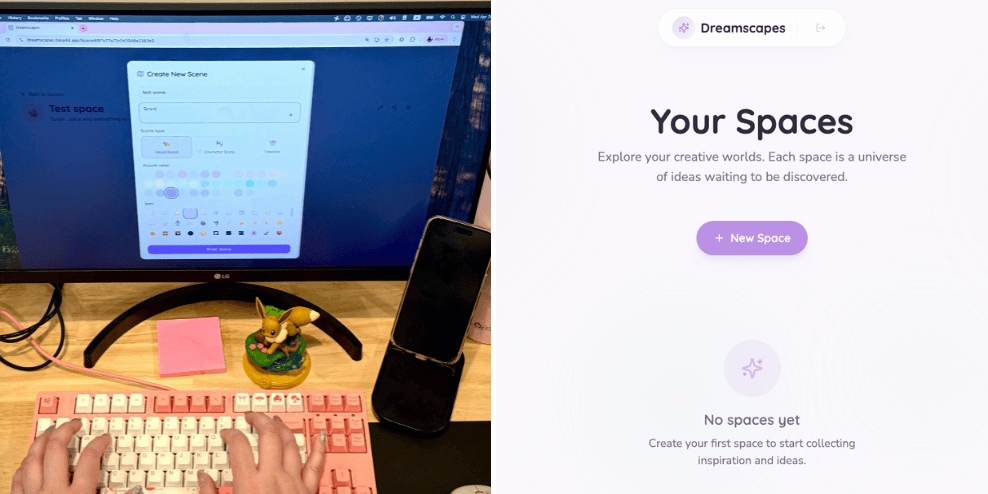
Vibe coding is addictive: build one app with AI, and suddenly, you’re tokenmaxxing your way through all the free credits.
That’s exactly what happened to me weeks after my experiment with building an Asana-inspired dashboard for my team.
This time, a friend asked me to build a Pinterest-style web app to help her create moodboards for a creative project. I wanted to see if I could do it within the free limit on the AI coding platform Base44, now that I’ve got more experience with vibe coding.
The experiment taught me the limits of my own capabilities as a nontechnical user and gave me an indicator of how far free credits on vibe-coding platforms can take you.
Building Dreamscapes
One requirement for my web app, which I called “Dreamscapes,” was to let users create multiple spaces to pin images and other digital materials.
I also wanted a function so the user — my friend — could share URLs for mood boards and story notes with creative collaborators.
I started by creating a detailed prompt on ChatGPT, then entered it into Base44’s system, and told it to start building an app for me.
Within Base44’s free credit limit, I found it hard to get the pin boards to work the way I wanted. It took me eight days’ worth of credits to get it to a usable state, making it the hardest vibe-coded project I’ve ever embarked on.

Aditi Bharade
Eventually, after much back-and-forth, my app had multiple functions.
Users can create “spaces,” pinboard-esque canvases with custom background colors.
Within each space are “scenes,” mini templates tailored to creatives looking to plan projects. Users can pick between three options: mood boards, character studies, and timelines.
Mood boards are the closest option to a Pinterest board in Dreamscapes. It’s still very much a repository of links to things — an electronic notebook with pretty pastel colors, rather than Pinterest’s continuous scrolling feed with algorithm-based suggestions.
Only knowing the basics of vibe coding isn’t enough
Dreamscapes is flawed in many ways.
I also found myself wishing I were more proficient in coding languages or better at prompting the Base44 AI assistant. Sometimes I found myself struggling to describe exactly what was wrong with the page.
For example, when the mood board glitched at the edges, or the notes function failed to load, I burned through daily credits because the AI didn’t know exactly what I wanted it to fix.
Project Mimic: Testing AI’s ability to replicate software
I never managed to get Dreamscapes to a point where it was usable on mobile. Some parts still load in a strange, glitchy way on my iPad, rendering it completely unusable. Within the free-to-use bandwidth on Base44, getting it up and running on the Apple App Store simply isn’t an option, either. Instead, it’s just a mini project that my friend and I can access on a web browser.
Things might have been different if I had used the paid version of Base44, which would have cost me upward of $40.
Pinterest, it is not
One of the biggest selling points of Pinterest is its sprawling corpus of images, whether user-contributed or pinned from the web. There aren’t any shortcuts to that for a hobbyist vibe coder.
And, like many software companies, Pinterest itself is embracing AI.
Ayumi Nakajima, senior director for content partnerships in Pinterest’s APAC division, told Business Insider that Pinterest has now evolved into an AI-powered “visual search and discovery platform, built for dreamscrolling, not doomscrolling.”
“Our inherent advantage has always been visual, and today, that advantage is powered by AI designed to understand taste, not just keywords,” Nakajima said. “Many AI models rely on what people type into a search bar. Pinterest’s unique difference is that we understand what people are drawn to — the styles, aesthetics, and nuances that are hard to put into words.”
Nakajima added that Pinterest’s understanding of taste and what people really want isn’t just algorithm-driven — the human users and creators on the platform help make it better.
So, while I’ve made a basic tool that lets my friend pin posts on a digital board, it’s incredibly basic compared to a platform like Pinterest. After all, Pinterest is a social network, and what I’ve made is an electronic scrapbook, at best — even if it required no coding skills to make.