
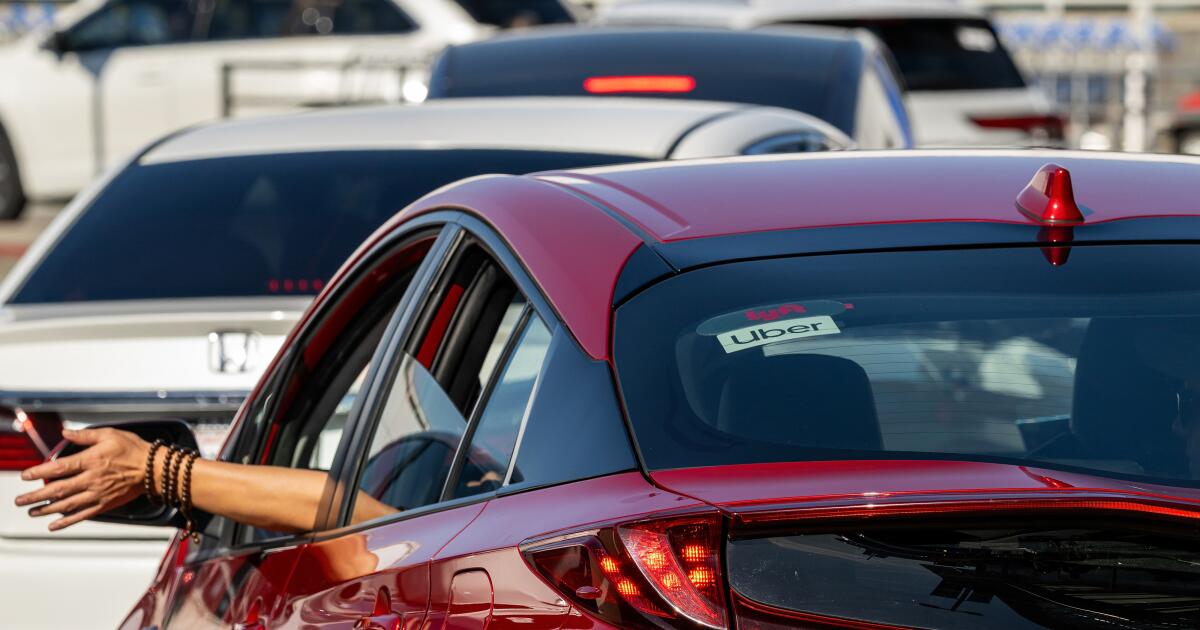
Eighteen years ago, two computer engineers said to be frustrated by their experience ordering a taxi in Paris hatched a wild idea: a mobile app that would allow users to hail a ride from their smartphones.
Their startup, known as Uber, initially clawed its way to success with a growth-at-all-costs strategy that sometimes involved operating without municipal consent, ignoring court orders and clashing with local regulations.
That ethos catapulted the maverick company to the top of the ride-sharing business, with its gig drivers providing nearly 14 billion trips last year globally.
Now, the San Francisco tech giant is at a crossroads, waging a bitter fight with state trial lawyers involving dueling ballot measures while it faces a raft of sexual assault lawsuits that could significantly increase its legal costs.
The outcome of the fight could have ramifications not only for California consumers, but for Uber’s ability to finance a multibillion-dollar expansion into the all-important robotaxi business — where it faces increasing competition from Waymo and Tesla.
“Uber is facing an existential threat where they’re not sure if robotaxis are going to be a margin enhancer or some very large competitive threat,” said Mark Giarelli, an analyst for Morningstar.
Uber has argued that it is well positioned to compete in the autonomous vehicle market and is opposing a ballot measure that would make it easier for the company to be found liable for alleged assaults committed by drivers.
“We wholeheartedly reject the narrative that we have not done enough to protect rider safety,” Uber spokesperson Zahid Arab said in an email. “The … ballot measure is being pushed by billboard lawyers who stand to collect larger fees, not safety advocates.”
The root of the escalating fight began last fall when Uber filed its own proposed ballot measure that would cap the contingency fees that personal injury lawyers charge in California accident cases.
“Billboard lawyers have gotten rich by scamming auto accident victims out of millions while driving up costs for everyone else. Our measure bans these predatory practices so accident victims — not billboard attorneys — actually take home the majority of their award,” said Nathan Click, spokesperson for the measure.
Uber’s ballot measure would lower its legal costs, which Chief Executive Dara Khosrowshahi told analysts have inflated its fares.
The measure would limit how much victims can recover for medical expenses and restrict attorneys fees so that accident victims retain at least 75% of any damages awarded, according to a state summary of the measure.
Contingency fees are typically about 33% but can rise to 40% or more in complicated cases requiring extensive medical care, expert witnesses and other expenses, attorneys say.
“Uber wants to push the fees so low, no lawyer will take the case and nobody will be able to hold it accountable in court,” Douglas Saeltzer, president of Consumer Attorneys of California.
Uber disputes the claim.
The trial attorneys’ competing measure would classify Uber as a “common carrier,” akin to a bus operator, effectively increasing its exposure to sexual assault cases involving Uber drivers. It also would mandate annual fingerprint checks, public reporting of sexual misconduct incidents and disclosure of an internal driver risk score on the Uber app.
“If you’re going to put somebody into the driver’s seat that you know wrongfully caused injury to somebody, you own that,” Saeltzer said.
More than 3,600 sexual assault cases
Uber is facing more than 3,100 sexual assault cases that have been consolidated in federal court in San Francisco and more than 500 state cases also combined under a Superior Court judge in the city.
Uber won the first “bellwether” case — intended to assist in determining a possible settlement of the lawsuits — last year in San Francisco. A jury determined the company was not liable in a state case involving a UC Santa Cruz student who said she fought off an assault by a driver in 2016.
However, in a separate case, a woman who said she was raped by her driver in 2023 while lying down in the back seat of an Uber after a night out in Tempe, Ariz., was awarded $8.5 million by a federal jury in February.
And last month, a woman was awarded $5,000 by a federal jury in North Carolina after claiming that in 2019 an Uber driver grabbed her inner thigh and propositioned her.
Uber has denied wrongdoing in both cases, arguing its drivers are independent contractors and that it operates a “technology platform” that is distinct from traditional “common carriers” such as buses and trains.
Attorney Bill Levin, one of the lead counsels in the California state cases, said the ballot measure’s classification of Uber as a common carrier would have a “significant” impact on the state cases.
“They would be left with defending the cases on the grounds that the driver didn’t do anything wrong and the plaintiff is to be disbelieved rather than blaming their own driver,” he said.
Attorney Sarah London, who represented the Arizona plaintiff, said she believes passage of the ballot measure could prompt other states to adopt similar legislation. “I think it could have profound effects across the country,” she said.
Arab disputed the claims, noting that no punitive damages have been awarded against Uber in the two cases it lost, indicating the company has “acted reasonably.”
“Safety is a top priority,” he said in a statement. “We’ve invested deeply in safety technology, carry some of the largest liability insurance in the industry, and have led the industry in developing safety tools and features for riders and drivers.”
The high stakes are highlighted by how much money has been raised by each side to convince voters of their positions. Uber has given more than $77 million, while an attorney-backed coalition has raised close to $69 million.
That kind of money paid for a 30-second add Uber ran during February’s Superbowl, railing against “billboard lawyers” who “make millions, while Californians are left broke and broken.” Personal injury attorneys sponsored their own ad attacking Uber’s ballot initiative.
Both measures have collected enough signatures to appear on November’s ballot, though they have yet to be verified by the Secretary of State’s office.
A threat from robotaxis
The political fight comes as the company under Khosrowshahi — who replaced controversial founder Travis Kalanick in 2017 — has seen revenue surge after a pandemic lull. Net income reached about $10 billion last year, up from a $9.1 billion loss three years earlier.
“It’s been a turnaround for the ages,” Wedbush anlayst Dan Ives said.
Still, despite the improved financial performance, the stock is well off its 52-week of nearly $102 last year. Shares closed at $73.61 Thursday.
The investor wariness reflects a new challenge: autonomous vehicles are disrupting the ride-hailing industry the way Uber once upended the taxi business.
It’s a potentially lucrative market but other companies are it chasing too.
“If you said, ‘What is the biggest long-term risk for the business model of Uber,’ it’s autonomous cars,” Ives said.
Sleek white Jaguar electric SUVs picking up passengers with a spinning laser roof sensor but no humans at the wheel are being operated by Waymo in markets across the U.S. The cars also have radar and high-resolution cameras.
That has put the Alphabet subsidiary in the driver’s seat in the costly race to dominate the next era of the ride hailing business. Its SUVs are estimated to cost more than $100,000.
Uber has responded aggressively, partnering with Waymo in some markets — where passengers can hail the Jaguars on the Uber platform — while working with competing AV makers such as Volkswagen, Amazon-backed robotaxi brand Zoox, and Irvine’s Rivian. Waymo, based in Mountain View, is considered a rival to Uber in other markets.
Long-term total costs for the initiatives could top $10 billion, Ives said.
Khosrowshahi told analysts last year the company’s plan it to have a “hybrid future” of human drivers and autonomous vehicles that would give it the most flexibility.
However, Giarelli said that Tesla presents a big threat if it is able to perfect its relatively inexpensive technology using high-resolution cameras and AI trained on the company’s vast database. Those cars could cost $30,000 to $40,000.
“Then the whole argument about Uber being an irreplaceable component of the AV ride-share supply chain is eliminated,” he said.
Khosrowshahi said that the company’s autonomous vehicle partners are using cameras, radar and laser imaging, called LiDAR. He doesn’t believe Tesla’s approach of using only camera’s will be adequate.
“I personally believe that autonomous vehicles have to have super human levels of safety,” he said in a podcast interview last year.
As it faces heavy competition, Uber has sought to lower its costs.
In 2020, Uber, Lyft and other gig companies spent around $200 million to pass Proposition 22, which essentially created a new class of independent workers entitled to limited benefits but not the full array of rights granted regular employees.
Last year, Gov. Newsom signed a bill that sharply lowered the coverage Uber and rival Lyft have to carry for accidents caused by uninsured or under-insured drivers from $1 million to $60,000 per individual and $300,000 per accident.
Still, Uber has been socking away billions into its insurance reserves to pay current and anticipated accident claims. The costs are passed on to riders, raising the price of fares.
The company’s insurance reserves have grown from $4 billion in 2021 to about $12.5 billion in 2025, according to regulatory filings. Uber operates its own insurer, a subsidiary called Aleka Insurance, in addition sharing risk with outside carriers.
Corporations can move profits into “captive” insurers to pay claims without paying taxes on that money. Funds ultimately not needed for claims also can be returned to the corporation tax advantaged, several tax experts told The Times.
A hidden war chest?
The rapid growth of the reserves has drawn scrutiny from one advocacy group.
L.A.-based Consumer Watchdog alleges in a report released this week that Uber is creating what amounts to a “hidden war chest” to free up billions of dollars on a tax-advantaged basis for robotaxis.
“This is a big big piggy bank for Uber that allows it to stash away money that can then be used for robotaxis or anything it wants at a later date if its campaign to limit liability is successful,” said Jamie Court, president of the group, which is partly funded by trial attorneys.
Brian Sullivan, executive editor of Risk Information, said that commercial vehicle insurers in general, which cover a variety of vehicles including big rigs, have been setting aside large reserves, citing costly personal injury lawsuits that result in large settlements.
Uber has not disclosed how much money it has set aside in Aleka but denied it is intentionally reserving too much money.
Arab cited the rising cost of claims and the company’s decision to take on more risk from outside insurers.
“Insurance reserves are … designed to ensure claims can be paid over time,” he said. “They are subject to rigorous accounting, audit, and regulatory requirements.”