
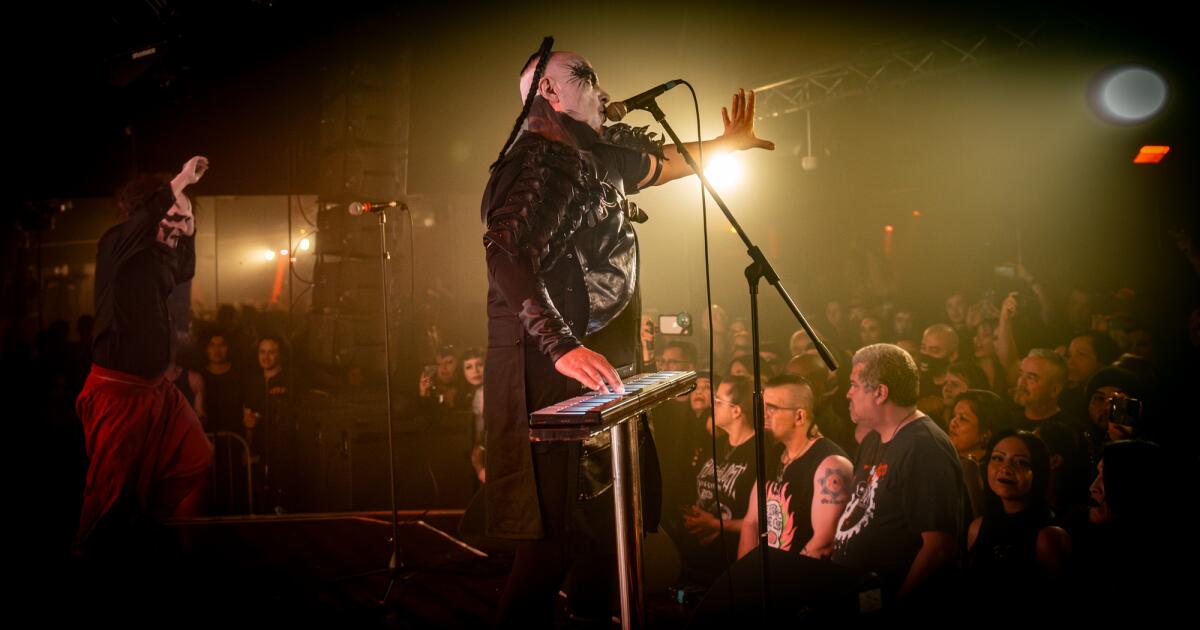
A club night dedicated to a niche, harsh subgenre of music would be lucky to last three years in a churning city like Los Angeles. But 30? That run makes the industrial club Das Bunker roughly as old as the original D Line.
It’s impossible to imagine Los Angeles’ electronic scene without Das Bunker, a roving party founded in Long Beach in 1996 by DJ and promoter John Giovanazzi to champion brutalist club music. While the scene waxed and waned over decades, it’s back in full force with young crowds today. Bands like Health can sell out the Palladium, electronic body music thrives on dance floors and Nine Inch Noize was a favorite at Coachella.
The party is now a fixture at Catch One in Mid-City, and Giovanazzi’s been celebrating the club’s milestone all year with sets by harsh European veterans like Das Ich and younger acts like Spike Hellis and Kontravoid. He spoke to The Times about L.A.’s tense climate for avant-garde nightlife, what Gen Z wants from extreme noise and how to be a good custodian of underground music history.
This interview was edited for length and clarity.
Thirty years is an insanely long run. Are you aware of anything that’s endured like that in L.A. nightlife?
Not really. Even nationwide, there’s not a whole lot. But the environment is so much different now than it used to be. Even festivals have been in such a weird spot the past couple of years. For the anniversary, I didn’t want to charge a triple digit entry price for one big party. It became obvious to me that the plan was to do a bunch of events that marked different styles and artists that we’ve focused on over the years. Not everything’s for everyone. This way, it felt like we could do something for everyone, just not at the same time.
Being able to go back and do things in our original location [Que Sera] in Long Beach has been something we’ve been talking about for years. The place is almost exactly the same, too, if you look at the old photos. I think the only difference is you can’t smoke inside anymore.
What was the climate like for industrial music in L.A. back when you started in the mid-’90s?
Back then, it was kind of on the decline, which was why we ended up starting in the first place. Labels were dumping artists left and right, and artists that already made names for themselves were transitioning to metal. There was this huge wave of artists out of Europe that were really cool, that got hardly any attention here at all. Clubs wouldn’t play them, record stores barely carried them.
Were there ever moments when you thought the club had run its course?
There was definitely a point around 2007 when we were like, “The current wave of the popularity of this stuff is not going to be sustainable.” The trend that was most alarming to me was that young people stopped coming out. We always track the ages of people who came to our events. We were 18-plus back then, and it got to the point where we were not getting anyone fresh out of high school coming to the club. That was a huge red flag for me that we had to dig deeper.
But that’s right around the time that the underground EBM [electronic body music] scene started coming out, which for me was very exciting. It was the first time that we had bands of that style that were actually from L.A. Previously, we always had to import these artists. So we doubled down on promoting that scene as much as possible. Our core crowd was not used to that, but I think the only reason we still exist is because we made that pivot.
What are young people discovering in this music today that feels exciting and dangerous?
It feels like you discovered something that’s not out there for everybody. Almost like a treasure hunt — “Hey, I discovered this thing at school. There’s this whole underground scene related to it, and this history and this lore, and lots of things you can explore, and cut your own path.” I’m seeing people get excited about these bands that were never popular in their heydays, which is kind of cool, but also funny. You see things trending on TikTok, and you’re just like, “Why this band?”
There is a ton of history and lore to this scene for curious young fans.
We lost a huge chunk of bands that were the stepping stones for where we’re at now. When MySpace disappeared, there were thousands of bands where that was the only place they had published music, and that’s just gone. I think that there’s a place for somebody to step in and tell that story, but I don’t think that’s me. I need a scene historian.
A lot of this music lives on the internet now. How do you keep Das Bunker thriving as a physical presence in L.A.?
When we thought Catch One was going out of business, they were remodeled into a much easier modular space. I try to program things that I know will get bodies out. Our noise room is probably our distinguishing feature, which is based off what we focused on in the late ‘90s. It’s subsidized by the bigger event, but it’s our most unique attribute. We try and preserve the vibe of the old days with that, because it’s a showcase of a genre that’s not even on streaming: ‘Come experience this thing that you can’t even find online.’
You don’t get many full-lifestyle music and fashion scenes like industrial anymore. Is that a casualty of the internet?
I personally don’t feel that there are many lifestyle subcultures that still exist, because you don’t have to get immersed in them to discover them anymore. It used to be that you found a goth song you liked, and you would buy the magazines and go to the club to hear the new music, and then you would start dressing like everyone else there and get assimilated. YouTube pretty much ended that for most subcultures, aside from, like, Juggalos.
The scene lost a founding legend in Nitzer Ebb’s Douglas McCarthy not long ago. What’s your role as a guardian of this music keeping its history alive?
I think that the best way to do that is to platform them. We just did a show with Das Ich, who are one of the weirdest acts to ever exist, in my opinion, who’ve been at it since the early ‘90s. We almost lost them when the singer had a brain aneurysm a couple years ago. So just being able to host them at all was kind of a big deal. We did a thing with Dirk Ivens right before the pandemic that was another one: :Hey, this is the guy who is responsible for like two-thirds of the styles of music that you guys listen to. You should come see him.”
More broadly, what’s the mood like for underground nightlife in L.A. these days? You’re clearly doing well, but you hear how hard it is to get people buying tickets.
It’s a little scary. Another promoter I was talking to said that it feels like every event now, you’re playing the video game on hard mode. The stakes are a lot higher with all the costs. It’s a lot more fulfilling and feels good when it goes well, though, and there are a lot of small places taking chances. You can’t just do the same thing over and over and expect people to show up.