
Julian Ryerson hadn’t learned to walk the last time Norway played in the World Cup. He was just 7 months old then, and if he had known his country was going to go 0 for the 21st century when it came to World Cup qualifying, he might have considered pursuing a sport other than soccer.
But that drought will finally end next week when Norway plays in the World Cup for the first time in nearly three decades.
“It’s been a long wait, especially for the Norwegian people,” he said. “They’ve been waiting as long as I am old. So yeah, I think everybody’s ready.”
How ready? Tens of thousands of fans gathered at a public square in Oslo to give the squad a roaring send-off. And the team’s official World Cup photo features the players dressed as Nordic warriors, weapons in hand, posed before a scenic fjord with long boats in the background.
Ryerson and Norway aren’t the only ones who will see their long waits end when the largest, most complex World Cup in history kicks off Thursday in Mexico City. Curacao, Cape Verde, Uzbekistan and Jordan will play in the tournament for the first time. The anticipation has been longest for Jordan, which played its first international match in 1953 and its first World Cup qualifier in 1986.
Haiti and the Democratic Republic of Congo, meanwhile, are back in the World Cup for the first time since 1974 — for Congo, it’s been so long the country was known as Zaire then. Iraq last qualified 40 years ago.
These countries owe their World Cup invitations to FIFA’s decision to expand the field from 32 to 48 teams, part of an effort both benevolent and self-serving.
Benevolent because the expansion created space for underrepresented regions in Africa, Asia and the Americans to participate, sparking additional interest in the sport there and unlocking funding and other support for national team programs. Self-serving because a larger tournament means more matches — 104 versus 64 in Qatar four years ago. FIFA projects that will produce an additional $1 billion in revenue from broadcast rights, sponsorships and ticket sales.
None of that diminishes anything for each of the 1,248 players who will participate. The phone call informing players they had made their national team for the tournament was, in many cases, the culmination of a lifelong dream. Even players such as Argentina’s Lionel Messi and Portugal’s Cristiano Ronaldo, who will each be playing in the World Cup for a record sixth time, don’t take that call for granted.
“It’s just something to be very thankful for,” said former world champion Philipp Lahm, who played in three World Cups for Germany. “For all three of them of those, just to be able to experience that.”
So consider the case of Ryerson, a defender who turned pro 11 years ago and was beginning to wonder if he’d ever get to his sport’s biggest stage.
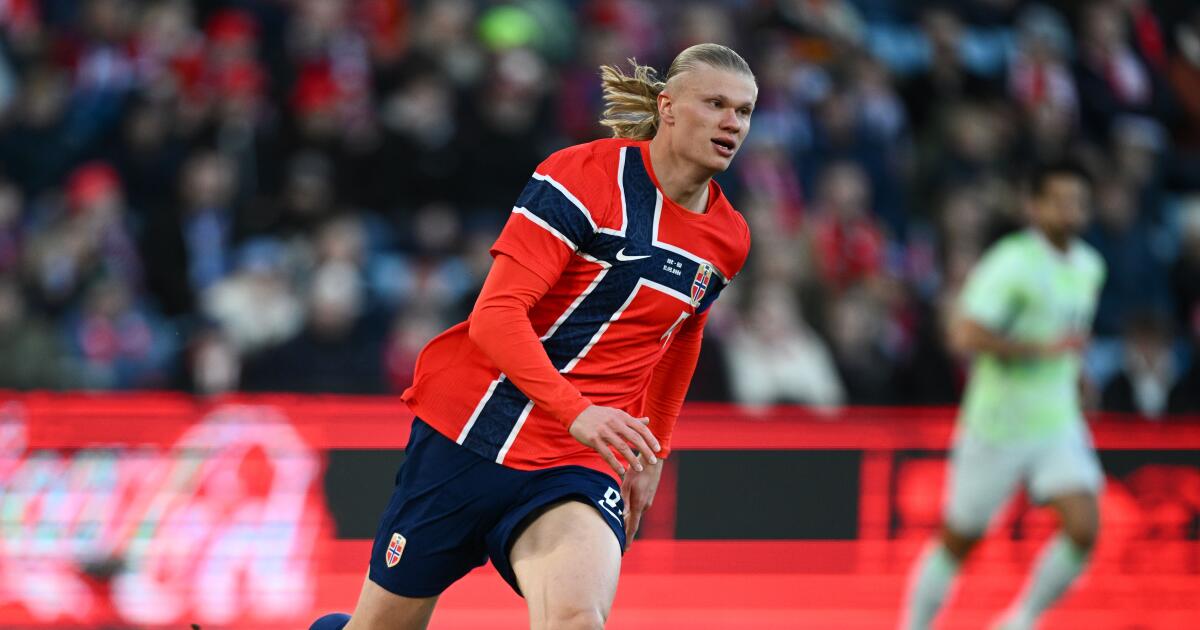
Erling Haaland of Norway controls the ball during an international friendly match against Switzerland on March 31.
(Stuart Franklin / Getty Images)
Norway was a soccer power in the 1990s, playing in consecutive World Cups and climbing to second in the FIFA world rankings. But after making its only appearance in the European championship in 2000, when Ryerson was 2, the country’s soccer program hit hard times, going 18 years without playing in a major international competition.
By the time Ryerson made his Norwegian debut in 2020, part of a young roster called up during the coronavirus pandemic, things were starting to turn around and that core of youngsters soon coalesced into a second golden generation.
“We’ve grown together,” he said. “We’ve never been as good as now.”
Heading that team is Thor-like striker Erling Haaland, a three-time Premier League scoring champion for Manchester City, who has more goals for club and country than Messi or Ronaldo had at the age of 25.
Ryerson also has achieved substantial club success while developing into a leader for Norway’s national team. Since arriving at Borussia Dortmund midway through the 2022-23 season, he has helped the team finish second in the Bundesliga twice and reach the Champions League final once. The UEFA coefficient, a complicated mathematical formula used to rank Europe’s 1,100-plus club teams, lists Dortmund 11th on the continent over the past five seasons.
Now comes a new challenge. Norway was drawn into arguably the most difficult of the 12 World Cup groups, one which includes France, ranked No. 1 in the world by FIFA, No. 14 Senegal, and Iraq. The top two teams automatically advance to the knockout rounds, as do eight of the 12 third-place teams, meaning one win in group play should be enough to see Norway through.
Anything short of that wouldn’t justify Norway’s long wait, Ryerson said.
“[We] managed to qualify but there’s so much left,” he said by phone from Germany. “It was a massive achievement for us. It was a special moment. [But] we have to get through the group phase. From there, you take it game by game.
“We have the quality to beat everybody. But we know the other teams also have that.”
Ryerson’s long-dreamed-about World Cup debut will come June 16, when Norway meets Iraq in Foxborough, Mass., though it could have come years earlier if he had chosen to play for the U.S. Because his father was born in Brooklyn and later lived in Fort Lauderdale, Fla., Ryerson was eligible to play for either Norway or the U.S., which has missed just one World Cup since 1990.
He chose Norway.
“We were there almost every year when I was a kid,” he said of visits to the U.S. side of his family. “It’s a small world.”
Not as small as the World Cup. Which is why, for players such as Julian Ryerson, it’s a dream come true just to make it on the field.
You have read the latest installment of On Soccer with Kevin Baxter. The weekly column takes you behind the scenes and shines a spotlight on unique stories. Listen to Baxter on this week’s episode of the “Corner of the Galaxy” podcast.